<?xml version="1.0" encoding="utf-8"?><feed xmlns="http://www.w3.org/2005/Atom" ><generator uri="https://jekyllrb.com/" version="4.4.1">Jekyll</generator><link href="https://www.scotxblog.com/feed.xml" rel="self" type="application/atom+xml" /><link href="https://www.scotxblog.com/" rel="alternate" type="text/html" /><updated>2026-05-07T03:22:11-05:00</updated><id>https://www.scotxblog.com/feed.xml</id><title type="html">SCOTXblog</title><subtitle>The Supreme Court of Texas Blog covers the pending Texas Supreme Court petitions that will shape Texas law, as well as other questions of Texas appellate law</subtitle><author><name>Don Cruse</name></author><entry><title type="html">We have the first grants under the Texas Supreme Court’s new petition rules</title><link href="https://www.scotxblog.com/2026/first-grants-under-new-scotx-petition-rules.html" rel="alternate" type="text/html" title="We have the first grants under the Texas Supreme Court’s new petition rules" /><published>2026-05-01T00:00:00-05:00</published><updated>2026-05-01T00:00:00-05:00</updated><id>https://www.scotxblog.com/2026/first-grants-under-new-scotx-petition-rules</id><content type="html" xml:base="https://www.scotxblog.com/2026/first-grants-under-new-scotx-petition-rules.html"><![CDATA[<p>This morning’s <a href="https://data.scotxblog.com/scotx/orders/2026-05-01">orders list</a> brought the first grants under the Texas Supreme Court’s new petition rules.</p>

<p>My website has been tracking these new petitions (more on that below), so I’ve been watching for the first grant. My hope had been that the first grants might answer some questions about how the internal process might be working (and, more selfishly, give me some material for my CLE talk in June).</p>

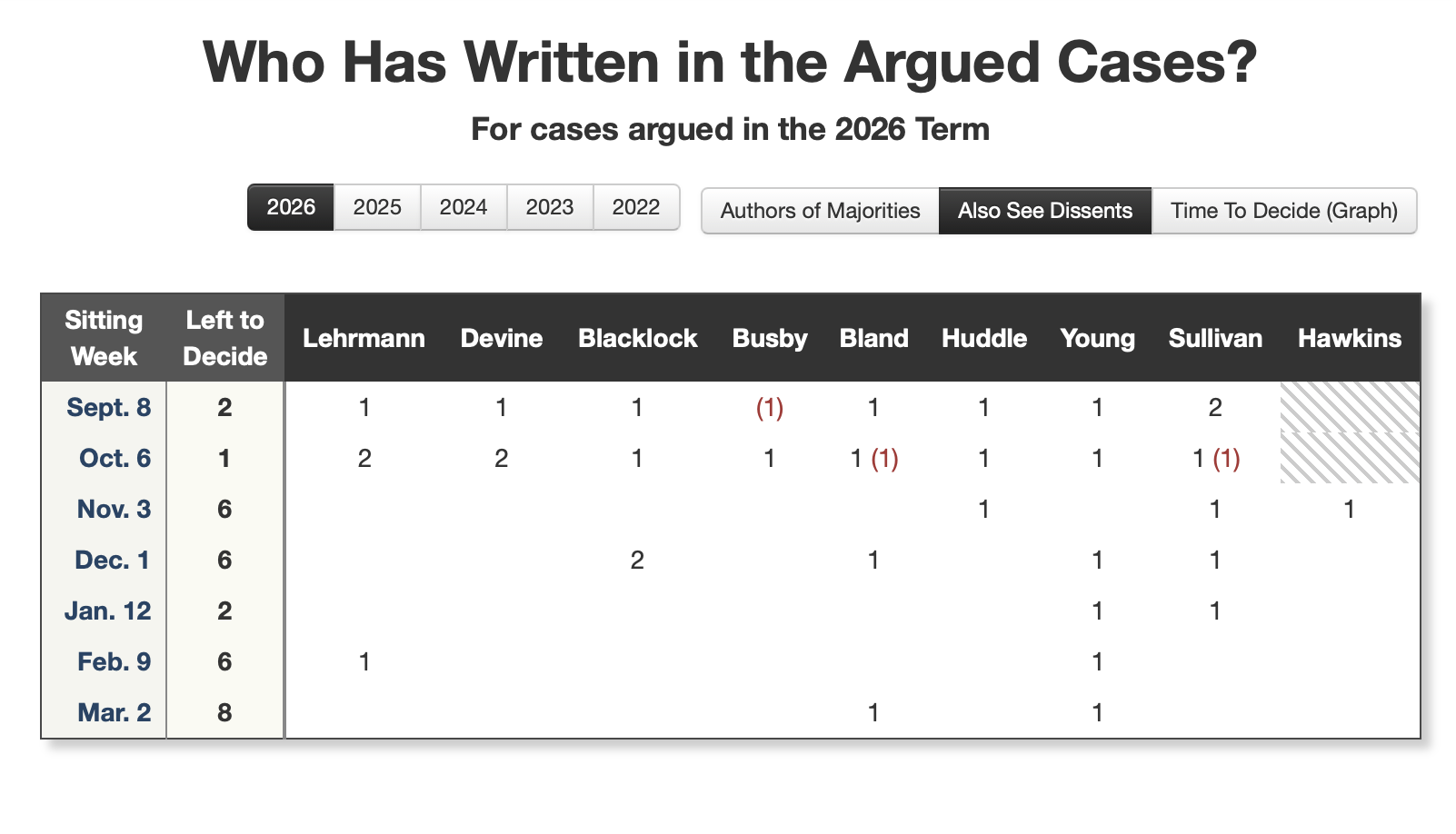
<p>Here is what I’ve been tracking, and where today’s grants fit in.</p>

<!--more-->

<h4 id="the-two-tracks-of-cases-moving-through-the-court">The two tracks of cases moving through the Court</h4>

<p>The defining feature of the Court’s new petition system is that it would allow these grant-or-deny decisions to be made off the petition and initial response, much like the U.S. Supreme Court handles its own petitions.<sup id="fnref:oldsystem"><a href="#fn:oldsystem" class="footnote" rel="footnote" role="doc-noteref">1</a></sup></p>

<p>But the Court is not starting from a blank slate. It begins with a full docket of its regular cases, accumulated under the old system.</p>

<p>For now, and the foreseeable future, the Texas Supreme Court will therefore be working on two tracks internally. Every case that was already on its docket before this year continues along under the old system. But the petitions filed since January 1st are under a brand-new set of rules.<sup id="fnref:visualize"><a href="#fn:visualize" class="footnote" rel="footnote" role="doc-noteref">2</a></sup> As I write on May 1st, there are already far more total petitions pending in the Court under its new rules than still remain under the old rules.<sup id="fnref:samesame"><a href="#fn:samesame" class="footnote" rel="footnote" role="doc-noteref">3</a></sup> But, as you’d also expect, the cases under the old rules tend to be those that received some earlier attention from the Court, including many in which the Court ordered full merits briefing.</p>

<h4 id="keeping-tabs-on-which-petitions-might-be-up-at-the-next-internal-conference">Keeping tabs on which petitions might be up at the next internal conference</h4>

<p>The new rules came with the possibility of faster up-or-down decisions on petitions.</p>

<p>To this point, the Court has been <em>denying</em> a steady flow of petitions under the new rules. But it has not yet <em>granted</em> any for review. The Court is requesting responses to petitions; those are being filed. Excluding parental-termination cases, the Court has requested a response to more than 50 regular petitions. Before today, none of those had been granted <em>or</em> denied.<sup id="fnref:parental"><a href="#fn:parental" class="footnote" rel="footnote" role="doc-noteref">4</a></sup></p>

<h4 id="this-week-the-court-made-its-first-grants-and-first-denials-of-petitions-under-its-new-rules">This week the Court made its first grants, and first denials, of petitions under its new rules</h4>

<p>The orders list showed three petition grants (with the two <em>San Patricio County Appraisal District</em> cases consolidated for oral argument):</p>

<p><a name="scotx_26-0128"></a></p>
<div class="caseup_standard" id="26-0128">
	<p><span class="caseup_caption"><a href="https://data.scotxblog.com/scotx/no/26-0128">DALLAS COUNTY v. KEITH LEONARD</a></span>, No. 26-0128</p>
	
	<div class="caseup_stage">Set to be argued on October  6, 2026</div>
	<div class="caseup_opinion_box">
</div>

</div>

<p><a name="scotx_26-0153"></a></p>
<div class="caseup_standard" id="26-0153">
	<p><span class="caseup_caption"><a href="https://data.scotxblog.com/scotx/no/26-0153">SAN PATRICIO COUNTY APPRAISAL DISTRICT v. DEVON GAS SERVICES, L.P., AS AGENT FOR GLENCORE LTD.</a></span>, No. 26-0153</p>
	
	<div class="caseup_stage">Set to be argued on October  6, 2026</div>
	<div class="caseup_opinion_box">
</div>

</div>

<p><a name="scotx_26-0157"></a></p>
<div class="caseup_standard" id="26-0157">
	<p><span class="caseup_caption"><a href="https://data.scotxblog.com/scotx/no/26-0157">SAN PATRICIO COUNTY APPRAISAL DISTRICT v. GUNVOR USA LLC</a></span>, No. 26-0157</p>
	
	<div class="caseup_stage">Chosen for future argument by order issued May  1, 2026</div>
	<div class="caseup_opinion_box">
</div>

</div>

<p>The <em>Dallas County</em> case is about the Texas Tort Claims Act. The two petitions brought by <em>San Patricio County Appraisal District</em> are pitched as being about “whether the State, via its interior local governments, will benefit from very significant revenues that result from the massive exportation of oil, NGL and LNG…”<sup id="fnref:pfrcited"><a href="#fn:pfrcited" class="footnote" rel="footnote" role="doc-noteref">5</a></sup></p>

<p>At this week’s conference, the Court also chose (for the first time under the new rules) to <em>deny</em> some of the petitions for which it had requested a response.<sup id="fnref:tooearly"><a href="#fn:tooearly" class="footnote" rel="footnote" role="doc-noteref">6</a></sup></p>

<h4 id="questions-for-the-future-for-me-at-least">Questions for the future (for me, at least)</h4>

<h5 id="the-timing-of-grants-relative-to-oral-argument">The timing of grants relative to oral argument</h5>

<p>The petitions granted today were set for oral argument October 6.</p>

<p>That kind of gap has always been typical for “grants” made during this spring period, when the Court has already finished hearing arguments for this term and is filling next term’s calendar.</p>

<p>What is worth keeping an eye on is how this gap fits — and may become the norm — for all “grants” under the new petition rules. According to the “Supreme Court Procedures Summary,” the Court’s hope is to leave enough time for each side to get an extension, in the regular course, and for all briefing to be complete at least 2 weeks before argument:</p>

<iframe src="https://embed.documentcloud.org/documents/27900080/annotations/2808971/?embed=1" style="border: 1px solid #d8dee2; border-radius: 0.5rem; width: 100%; height: 300px; box-sizing: content-box;"></iframe>
<script src="https://embed.documentcloud.org/embed/dc-resize.js"></script>

<p>It looks like the Court <em>exactly</em> hit that target today.</p>

<p>By my math, the regular briefing schedule (with each side taking an extension on their opening brief) would see the reply brief filed on September 21, 2026 — two weeks before argument.</p>

<h5 id="do-we-know-anything-yet-about-when-petitions-will-be-listed-for-conference">Do we know anything (yet) about when petitions will be listed for conference?</h5>

<p>Another timing issue I’m wondering about is <em>when</em> petitions filed under these new rules will be put on the Court’s internal conference agenda for this grant-or-deny decision.</p>

<p>The old IOPs (at least at one time) suggested that petitions were set for the first conference thirty days after the response was filed, leaving time for a reply to be filed in the normal course.</p>

<p>The newly issued “Supreme Court Procedures Summary” is more circumspect. It says that a petition goes onto the conference agenda “after” the deadline for a reply. But it does not say how many days after, or measured from when.</p>

<iframe src="https://embed.documentcloud.org/documents/27900080/annotations/2814291/?embed=1" style="border: 1px solid #d8dee2; border-radius: 0.5rem; width: 100%; height: 300px; box-sizing: content-box;"></iframe>
<script src="https://embed.documentcloud.org/embed/dc-resize.js"></script>

<p>Before today, I had guessed that the usual timing might be 30 days after a response was filed. With that in mind, I recently added an experimental column to the page on my site that <a href="https://data.scotxblog.com/scotx/staging/pfr_new#with-response">tracks petitions that have a response on file</a> for the “Initial Conference.” That column, today at least, shows which of the Court’s publicly listed conference dates is the first that falls at least 30 days after the response.</p>

<p>Most of today’s “denials” were, in fact, petitions that fit that schedule. But today’s “grants” actually came in some cases where the response was filed <em>less than</em> 30 days before the conference. It’s <em>possible</em> that is because the Court chose some petitions for accelerated treatment (perhaps in an effort to leave enough time before an October 6 argument date). It’s very possible that the Court just hasn’t settled into a reliable pattern yet. Or that there’s no reliable pattern to be found.</p>

<p>I’ll be adjusting the knobs and dials of this “conference date” column, as we learn more. In the meantime, you can use that page on my website to see which petitions <em>may</em> be up for conference.</p>
<div class="footnotes" role="doc-endnotes">
  <ol>
    <li id="fn:oldsystem">
      <p>That differs from the familiar old system in Texas, under which the Court would defer its grant-or-deny decision until after ordering full merits briefing. You can read more about these differences in this <a href="https://www.scotxblog.com/2026/scotx-internal-operating-procedures.html">prior post</a>. <a href="#fnref:oldsystem" class="reversefootnote" role="doc-backlink">&#8617;</a></p>
    </li>
    <li id="fn:visualize">
      <p>I’ve given some thought to <a href="https://www.scotxblog.com/2026/preparing-the-way.html">how to visualize these two tracks</a>. That chart should change pretty dramatically after the Court has finished issuing opinions for its argued cases in June. <a href="#fnref:visualize" class="reversefootnote" role="doc-backlink">&#8617;</a></p>
    </li>
    <li id="fn:samesame">
      <p>When I took a snapshot in March, it caught a moment when the two tracks happened to be exactly equal in total size. You can see the current sizes on <a href="https://data.scotxblog.com/scotx/staging">this page</a>. <a href="#fnref:samesame" class="reversefootnote" role="doc-backlink">&#8617;</a></p>
    </li>
    <li id="fn:parental">
      <p>Including parental-termination cases, the Court has (as of today) only denied one petition with a response request. <a href="#fnref:parental" class="reversefootnote" role="doc-backlink">&#8617;</a></p>
    </li>
    <li id="fn:pfrcited">
      <p>This is quoting the Introduction of the petition in <a name="scotx_26-0153"></a><span class="caseup_inline_caption" id="caption_26-0153" style="font-style: italic;"><a href="https://data.scotxblog.com/scotx/no/26-0153">San Patricio County Appraisal District v. Devon Gas Services, L.P., as Agent for Glencore Ltd.</a></span>, <span class="caseup_inline_docket_no">No. 26-0153</span>. <a href="#fnref:pfrcited" class="reversefootnote" role="doc-backlink">&#8617;</a></p>
    </li>
    <li id="fn:tooearly">
      <p>It’s too early to do the math about grant rates. I’m hoping for a few more data points by early June. <a href="#fnref:tooearly" class="reversefootnote" role="doc-backlink">&#8617;</a></p>
    </li>
  </ol>
</div>]]></content><author><name>Don Cruse</name></author><category term="Practice Notes" /><category term="Case Notes" /><summary type="html"><![CDATA[This morning’s orders list brought the first grants under the Texas Supreme Court’s new petition rules. My website has been tracking these new petitions (more on that below), so I’ve been watching for the first grant. My hope had been that the first grants might answer some questions about how the internal process might be working (and, more selfishly, give me some material for my CLE talk in June). Here is what I’ve been tracking, and where today’s grants fit in. The two tracks of cases moving through the Court The defining feature of the Court’s new petition system is that it would allow these grant-or-deny decisions to be made off the petition and initial response, much like the U.S. Supreme Court handles its own petitions.1 But the Court is not starting from a blank slate. It begins with a full docket of its regular cases, accumulated under the old system. For now, and the foreseeable future, the Texas Supreme Court will therefore be working on two tracks internally. Every case that was already on its docket before this year continues along under the old system. But the petitions filed since January 1st are under a brand-new set of rules.2 As I write on May 1st, there are already far more total petitions pending in the Court under its new rules than still remain under the old rules.3 But, as you’d also expect, the cases under the old rules tend to be those that received some earlier attention from the Court, including many in which the Court ordered full merits briefing. Keeping tabs on which petitions might be up at the next internal conference The new rules came with the possibility of faster up-or-down decisions on petitions. To this point, the Court has been denying a steady flow of petitions under the new rules. But it has not yet granted any for review. The Court is requesting responses to petitions; those are being filed. Excluding parental-termination cases, the Court has requested a response to more than 50 regular petitions. Before today, none of those had been granted or denied.4 This week the Court made its first grants, and first denials, of petitions under its new rules The orders list showed three petition grants (with the two San Patricio County Appraisal District cases consolidated for oral argument): [texapp docket_no=”26-0128”] [texapp docket_no=”26-0153”] [texapp docket_no=”26-0157”] The Dallas County case is about the Texas Tort Claims Act. The two petitions brought by San Patricio County Appraisal District are pitched as being about “whether the State, via its interior local governments, will benefit from very significant revenues that result from the massive exportation of oil, NGL and LNG…”5 At this week’s conference, the Court also chose (for the first time under the new rules) to deny some of the petitions for which it had requested a response.6 Questions for the future (for me, at least) The timing of grants relative to oral argument The petitions granted today were set for oral argument October 6. That kind of gap has always been typical for “grants” made during this spring period, when the Court has already finished hearing arguments for this term and is filling next term’s calendar. What is worth keeping an eye on is how this gap fits — and may become the norm — for all “grants” under the new petition rules. According to the “Supreme Court Procedures Summary,” the Court’s hope is to leave enough time for each side to get an extension, in the regular course, and for all briefing to be complete at least 2 weeks before argument: It looks like the Court exactly hit that target today. By my math, the regular briefing schedule (with each side taking an extension on their opening brief) would see the reply brief filed on September 21, 2026 — two weeks before argument. Do we know anything (yet) about when petitions will be listed for conference? Another timing issue I’m wondering about is when petitions filed under these new rules will be put on the Court’s internal conference agenda for this grant-or-deny decision. The old IOPs (at least at one time) suggested that petitions were set for the first conference thirty days after the response was filed, leaving time for a reply to be filed in the normal course. The newly issued “Supreme Court Procedures Summary” is more circumspect. It says that a petition goes onto the conference agenda “after” the deadline for a reply. But it does not say how many days after, or measured from when. Before today, I had guessed that the usual timing might be 30 days after a response was filed. With that in mind, I recently added an experimental column to the page on my site that tracks petitions that have a response on file for the “Initial Conference.” That column, today at least, shows which of the Court’s publicly listed conference dates is the first that falls at least 30 days after the response. Most of today’s “denials” were, in fact, petitions that fit that schedule. But today’s “grants” actually came in some cases where the response was filed less than 30 days before the conference. It’s possible that is because the Court chose some petitions for accelerated treatment (perhaps in an effort to leave enough time before an October 6 argument date). It’s very possible that the Court just hasn’t settled into a reliable pattern yet. Or that there’s no reliable pattern to be found. I’ll be adjusting the knobs and dials of this “conference date” column, as we learn more. In the meantime, you can use that page on my website to see which petitions may be up for conference. That differs from the familiar old system in Texas, under which the Court would defer its grant-or-deny decision until after ordering full merits briefing. You can read more about these differences in this prior post. &#8617; I’ve given some thought to how to visualize these two tracks. That chart should change pretty dramatically after the Court has finished issuing opinions for its argued cases in June. &#8617; When I took a snapshot in March, it caught a moment when the two tracks happened to be exactly equal in total size. You can see the current sizes on this page. &#8617; Including parental-termination cases, the Court has (as of today) only denied one petition with a response request. &#8617; This is quoting the Introduction of the petition in [texapptext docket_no=”26-0153”]. &#8617; It’s too early to do the math about grant rates. I’m hoping for a few more data points by early June. &#8617;]]></summary></entry><entry><title type="html">The e-filing notices that led to a law firm’s disqualification</title><link href="https://www.scotxblog.com/2026/disqualification-case.html" rel="alternate" type="text/html" title="The e-filing notices that led to a law firm’s disqualification" /><published>2026-04-30T14:35:03-05:00</published><updated>2026-04-30T14:35:03-05:00</updated><id>https://www.scotxblog.com/2026/disqualification-case</id><content type="html" xml:base="https://www.scotxblog.com/2026/disqualification-case.html"><![CDATA[<blockquote>
  <p><em>… a mind’s inner workings are often opaque and its contents not easily partitioned.</em></p>
</blockquote>

<h4 id="a-disqualification-case-with-some-cautions-for-appellate-lawyers">A disqualification case with some cautions for appellate lawyers</h4>

<p><a name="scotx_24-0245"></a></p>
<div class="caseup_standard" id="24-0245">
	<p><span class="caseup_caption"><a href="https://data.scotxblog.com/scotx/no/24-0245">IN RE ADEEL ZAIDI, A.K. CHAGLA AND PRESTIGE CONSULTING D/B/A TURNAROUND MANAGEMENT GROUP</a></span>, No. 24-0245</p>
	
	<div class="caseup_stage"></div>
	<div class="caseup_opinion_box">
		<div class="caseup_single_opinion" style="width: 50%;">
		      <img src="https://static.scotxblog.com/assets/justices/41/devine-b22852e7ffa17a22397ce57e9886318813502271688a4e14b2eb4e9de9a5929c.jpg" alt="Devine" />
		          <img src="https://static.scotxblog.com/assets/justices/41/lehrmann-17cdb2d973fac22ab168cd4dcdadad9c5bf64c361ba11931b87c8cd0d35bef37.jpg" alt="Lehrmann" />
		          <img src="https://static.scotxblog.com/assets/justices/41/blacklock-012bcde104e8598de17c75ade5374abc9dc95fb00ffc4bf9fed07cdc090601c8.jpg" alt="Blacklock" />
		          <img src="https://static.scotxblog.com/assets/justices/41/busby-a8706a0bdf849f17600f1ee2376e3e5e3c8ae3af11d708ee4d277fddcd984a5f.jpg" alt="Busby" />
		          <img src="https://static.scotxblog.com/assets/justices/41/huddle-888ea41870be886d8d37492aa883bd47a7eba3d6afbb05a6d396070796e2cfab.jpg" alt="Huddle" />
		          <img src="https://static.scotxblog.com/assets/justices/41/young-4ab784f08f1deba32befff849488f0948512265302100188c353758c44e63365.jpg" alt="Young" />
		          <img src="https://static.scotxblog.com/assets/justices/41/sullivan-08679a97652f30f21e02e17fd686dc55e7ac2883b01fbd7616218c99a27b453d.jpg" alt="Sullivan" />
		          <img src="https://static.scotxblog.com/assets/justices/41/hawkins-bb35f72fcde66331f4b78bcb959d54483156ae4ce13f1c7329b6e75fc691b2ef.jpg" alt="Hawkins" />
		<br />
		<div class="caseup_opinion_link">
			<a href="http://docs.texasappellate.com/scotx/op/24-0245/2026-04-10.devine.pdf">Opinion of the Court</a>
			
			
		</div>
		</div>
		
</div>

</div>

<p>Earlier this month, the Texas Supreme Court issued an attorney-disqualification opinion. The court’s guidance — and its strict rule of disqualification — actually applies to any law firm big enough to employ non-lawyer support staff.</p>

<p>This opinion might make you read Texas e-filing notices a little more carefully. (And the fact pattern here might make you wish that your firm’s lawyers all knew how to make e-filings themselves, rather than delegating that task to staff.)</p>

<!--more-->

<h4 id="what-led-this-law-firm-to-be-disqualified">What led this law firm to be disqualified</h4>

<p>Lawsuits can tend to linger. This case began in 2009, and at that time the plaintiff had two law firms. One of those firms employed a legal assistant who, quite naturally, came into contact with confidential materials. In 2011, that legal assistant moved to a new law firm.</p>

<p>The case continued to a bench trial. The defendant’s side hired an appellate lawyer, who ultimately won a reversal and remand for a new trial in 2016. Around that time, the defendant’s appellate lawyer joined a larger law firm — which was, unluckily, the same firm that had hired this legal assistant.</p>

<p>At that point, there was a conflict. The legal assistant had, five years after starting a new job, suddenly become “side-switching legal staff.” On this record, the conflict did become more than theoretical. The opinion tells us that, from 2017 to 2022, the legal assistant did some work on this case “on thirteen occasions,” including some “limited” secretarial services when a lawyer’s regular assistant was unavailable. Crucially to how things played out here, the legal assistant also helped with the mechanics of making two e-filings for this case in 2022. Those standard Texas e-filing notices listed the legal assistant’s name as the one who made the filing on the attorney’s behalf.</p>

<p>In January 2023, when looking back through some of the e-filings from 2022, lawyers on the plaintiff’s side recognized the name of this legal assistant. They filed a motion to disqualify in March 2023.</p>

<p>The trial court granted disqualification. When doing so, the trial court rejected a waiver argument based on the idea that too much time had passed between the 2022 e-filing notices and the March 2023 motion to disqualify. The court of appeals upheld the disqualification, with a one-sentence mandamus denial. The Texas Supreme Court set the mandamus petition for oral argument, which was heard in October. The Court ultimately upheld the disqualification.</p>

<h4 id="a-minds-inner-workings-are-often-opaque-and-its-contents-not-easily-partitioned">“a mind’s inner workings are often opaque and its contents not easily partitioned”</h4>

<p>The Court called the legal rule here “longstanding” and “bright-line.” “[S]ide-switching legal staff requires disqualification unless minimal prophylactic measures were undertaken to safeguard prior client confidences from the risk of inadvertent disclosure.” The test has two prongs. It requires “both an instruction <em>and</em> other reasonable steps” to reduce the risk of the side-switching legal staff becoming involved in the matter. (page 20)</p>

<p>The defendants argued in part that “an admonishment would have had little effect when the legal assistant was hired because the conflict did not arise until years later.” The Court disagreed. Its reason was less practical than aspirational. “In our experience, paralegals, secretaries, and other legal assistants aiding the bar are, by and large, commendably diligent, respectful, and ethical. … We are confident most legal staff, when admonished, will faithfully comply to the best of their abilities and not work on conflicted matters, including those that arise years later.” (page 12)</p>

<p>The Court defended having a rigid bright-line rule about admonitions by pointing to the limits of human memory. Once years have passed, it may be difficult to know what information a staff member may have been exposed to. In contrast to mishandled paper documents — for which it might be theoretically possible to discern precisely what information was involved — “a mind’s inner workings are often opaque and its contents not easily partitioned.” (page 19)</p>

<h4 id="forgetful-inattentive-or-even-potentially-rogue-nonlawyers">“forgetful, inattentive, or even potentially rogue nonlawyers”</h4>

<p>The test has two necessary steps. There must be “both an instruction <em>and</em> other reasonable steps” to prevent cross-contamination. (page 20) Without proof of that initial step of the “instruction” or admonition, disqualification is required. No “reasonable steps” can salvage the situation.</p>

<p>In a footnote, the Court explains that, in combination, these two prongs are meant to:</p>

<blockquote>
  <p>reduce the risk of disclosure to an acceptable level by addressing two types of nonlawyers. Generally speaking, the first prong is directed at ethical nonlawyers who will comply with instructions while the fact-intensive second prong is geared toward forgetful, inattentive, or even potentially rogue nonlawyers. … However, an ethical nonlawyer may be forgetful or careless at times — such is the lot of human nature — and other reasonable steps provide guardrails to support an instruction. And even a rogue nonlawyer may be more likely to abide if admonished. Thus, both prongs are necessary, but neither is sufficient on its own to satisfy the test. (page 20 note 63)</p>
</blockquote>

<h4 id="e-filing-notices-are-notices">E-filing notices are <em>notices</em></h4>

<p>The easy practical takeaway is: Admonish early and often. Admonish newly hired staff. Admonish staff, again, when your firm brings on new counsel who carry their own bundle of conflicts. Send the memo; save the email somewhere safe. Unless you can establish that you met the first prong with an admonition (at some relevant time), the reasonableness of your other protocols will not matter.</p>

<p>The other takeaway may be that e-filing notices are <em>notices</em>, of a sort.</p>

<p>This conflict surfaced because of some e-filing notices. But those same notices almost — and on a different record might have — unraveled the disqualification argument by waiver.</p>

<p>The defendant argued that these notices should have put the other side on notice. “Under the defendants’ theory, the plaintiffs were on notice, as a matter of law, nearly a year earlier when the case documents with the e-filing notifications listing the legal assistant’s name were filed in March 2022. If so, an unexplained one-year delay before filing the disqualification motion would be unquestionably dilatory.” (page 22)</p>

<p>The Court held this mandamus record was not strong enough to establish waiver as a matter of law. And that standard of review was pivotal to the Court’s explanation of its decision. In general, “[a] disputed fact issue on intention precludes mandamus relief, as ‘we may not make factual determinations in mandamus proceedings.’” (page 23) The explanations offered here were reasonable enough, at least as filtered through the standard of review. That said, it’s easy to imagine slightly different facts — such as if the side-switching staff member had worked for the other side’s current lawyers, rather than a firm that withdrew more than a decade ago — where a trial court might easily find that e-filing notices like these do start the clock for waiver.</p>]]></content><author><name>Don Cruse</name></author><category term="Case Notes" /><summary type="html"><![CDATA[… a mind’s inner workings are often opaque and its contents not easily partitioned. A disqualification case with some cautions for appellate lawyers [texapp docket_no=”24-0245”] Earlier this month, the Texas Supreme Court issued an attorney-disqualification opinion. The court’s guidance — and its strict rule of disqualification — actually applies to any law firm big enough to employ non-lawyer support staff. This opinion might make you read Texas e-filing notices a little more carefully. (And the fact pattern here might make you wish that your firm’s lawyers all knew how to make e-filings themselves, rather than delegating that task to staff.) What led this law firm to be disqualified Lawsuits can tend to linger. This case began in 2009, and at that time the plaintiff had two law firms. One of those firms employed a legal assistant who, quite naturally, came into contact with confidential materials. In 2011, that legal assistant moved to a new law firm. The case continued to a bench trial. The defendant’s side hired an appellate lawyer, who ultimately won a reversal and remand for a new trial in 2016. Around that time, the defendant’s appellate lawyer joined a larger law firm — which was, unluckily, the same firm that had hired this legal assistant. At that point, there was a conflict. The legal assistant had, five years after starting a new job, suddenly become “side-switching legal staff.” On this record, the conflict did become more than theoretical. The opinion tells us that, from 2017 to 2022, the legal assistant did some work on this case “on thirteen occasions,” including some “limited” secretarial services when a lawyer’s regular assistant was unavailable. Crucially to how things played out here, the legal assistant also helped with the mechanics of making two e-filings for this case in 2022. Those standard Texas e-filing notices listed the legal assistant’s name as the one who made the filing on the attorney’s behalf. In January 2023, when looking back through some of the e-filings from 2022, lawyers on the plaintiff’s side recognized the name of this legal assistant. They filed a motion to disqualify in March 2023. The trial court granted disqualification. When doing so, the trial court rejected a waiver argument based on the idea that too much time had passed between the 2022 e-filing notices and the March 2023 motion to disqualify. The court of appeals upheld the disqualification, with a one-sentence mandamus denial. The Texas Supreme Court set the mandamus petition for oral argument, which was heard in October. The Court ultimately upheld the disqualification. “a mind’s inner workings are often opaque and its contents not easily partitioned” The Court called the legal rule here “longstanding” and “bright-line.” “[S]ide-switching legal staff requires disqualification unless minimal prophylactic measures were undertaken to safeguard prior client confidences from the risk of inadvertent disclosure.” The test has two prongs. It requires “both an instruction and other reasonable steps” to reduce the risk of the side-switching legal staff becoming involved in the matter. (page 20) The defendants argued in part that “an admonishment would have had little effect when the legal assistant was hired because the conflict did not arise until years later.” The Court disagreed. Its reason was less practical than aspirational. “In our experience, paralegals, secretaries, and other legal assistants aiding the bar are, by and large, commendably diligent, respectful, and ethical. … We are confident most legal staff, when admonished, will faithfully comply to the best of their abilities and not work on conflicted matters, including those that arise years later.” (page 12) The Court defended having a rigid bright-line rule about admonitions by pointing to the limits of human memory. Once years have passed, it may be difficult to know what information a staff member may have been exposed to. In contrast to mishandled paper documents — for which it might be theoretically possible to discern precisely what information was involved — “a mind’s inner workings are often opaque and its contents not easily partitioned.” (page 19) “forgetful, inattentive, or even potentially rogue nonlawyers” The test has two necessary steps. There must be “both an instruction and other reasonable steps” to prevent cross-contamination. (page 20) Without proof of that initial step of the “instruction” or admonition, disqualification is required. No “reasonable steps” can salvage the situation. In a footnote, the Court explains that, in combination, these two prongs are meant to: reduce the risk of disclosure to an acceptable level by addressing two types of nonlawyers. Generally speaking, the first prong is directed at ethical nonlawyers who will comply with instructions while the fact-intensive second prong is geared toward forgetful, inattentive, or even potentially rogue nonlawyers. … However, an ethical nonlawyer may be forgetful or careless at times — such is the lot of human nature — and other reasonable steps provide guardrails to support an instruction. And even a rogue nonlawyer may be more likely to abide if admonished. Thus, both prongs are necessary, but neither is sufficient on its own to satisfy the test. (page 20 note 63) E-filing notices are notices The easy practical takeaway is: Admonish early and often. Admonish newly hired staff. Admonish staff, again, when your firm brings on new counsel who carry their own bundle of conflicts. Send the memo; save the email somewhere safe. Unless you can establish that you met the first prong with an admonition (at some relevant time), the reasonableness of your other protocols will not matter. The other takeaway may be that e-filing notices are notices, of a sort. This conflict surfaced because of some e-filing notices. But those same notices almost — and on a different record might have — unraveled the disqualification argument by waiver. The defendant argued that these notices should have put the other side on notice. “Under the defendants’ theory, the plaintiffs were on notice, as a matter of law, nearly a year earlier when the case documents with the e-filing notifications listing the legal assistant’s name were filed in March 2022. If so, an unexplained one-year delay before filing the disqualification motion would be unquestionably dilatory.” (page 22) The Court held this mandamus record was not strong enough to establish waiver as a matter of law. And that standard of review was pivotal to the Court’s explanation of its decision. In general, “[a] disputed fact issue on intention precludes mandamus relief, as ‘we may not make factual determinations in mandamus proceedings.’” (page 23) The explanations offered here were reasonable enough, at least as filtered through the standard of review. That said, it’s easy to imagine slightly different facts — such as if the side-switching staff member had worked for the other side’s current lawyers, rather than a firm that withdrew more than a decade ago — where a trial court might easily find that e-filing notices like these do start the clock for waiver.]]></summary></entry><entry><title type="html">Guidance from the Texas Supreme Court about how the new petition rules will work</title><link href="https://www.scotxblog.com/2026/scotx-internal-operating-procedures.html" rel="alternate" type="text/html" title="Guidance from the Texas Supreme Court about how the new petition rules will work" /><published>2026-03-26T11:00:00-05:00</published><updated>2026-03-26T11:00:00-05:00</updated><id>https://www.scotxblog.com/2026/scotx-internal-operating-procedures</id><content type="html" xml:base="https://www.scotxblog.com/2026/scotx-internal-operating-procedures.html"><![CDATA[<h3 id="iops-vs-inferred-operating-procedures">IOPs vs. “inferred” operating procedures</h3>

<p>For a number of years, the Texas Supreme Court published a set of “internal operating procedures” (IOPs) on its website, with a detailed look at the internal process. The most recent update to that document (of which I am aware) was in 2018.<sup id="fnref:cleabout"><a href="#fn:cleabout" class="footnote" rel="footnote" role="doc-noteref">1</a></sup></p>

<p>Having published that document did not stop the Court from experimenting. As members of the Court had new ideas, or prevailed on their colleagues to revisit older ideas, the <em>actual</em> practice at the Court would change in ways not reflected in the IOPs. (Eventually, the Court removed that 2018 document from its website.)</p>

<!--more-->

<p>My own CLE presentations would typically have a “show and tell” section, with unusual procedural things I had seen in the SCOTX docket. Members of the Court would sometimes be asked about those at panel discussions, even at the same conference. The result was a kind of oral folk knowledge about the Court’s practices. At least once, something was so unusual that it broke through to the legal press even before a conference. That was the April 2022 decision by the Court to grant a petition for review based on the petition alone, before requesting merits briefs.<sup id="fnref:christcase"><a href="#fn:christcase" class="footnote" rel="footnote" role="doc-noteref">2</a></sup></p>

<p>That turned out to foreshadow the new petition rules, effective January 2026.<sup id="fnref:newredline"><a href="#fn:newredline" class="footnote" rel="footnote" role="doc-noteref">3</a></sup></p>

<h3 id="an-official-summary-of-the-new-rules">An official “summary” of the new rules</h3>

<p>When the Court issued its new petition rules, it attached a memo. That struck me as very unusual; I’m not aware of the Court previously using its rule-making process to issue this kind of memo to the bar.</p>

<p>In many ways, this seems to be a bullet-pointed version of the old Internal Operating Procedures. It’s the prose of a memo, not the poetry of a rule. The memo does discuss the new petition rules to which it was attached; what it says about those should be read with interest. But it goes much farther. It puts those rules in a larger context, talking about internal court procedures like what number of justices are needed to vote for different outcomes, and the Court’s expectations about how motions to extend time will work under the new system.</p>

<p>Here’s the memo. The annotations in yellow are mine (not the Court’s), and they highlight some of the changes that may be of particular interest to Texas appellate lawyers.</p>

<iframe src="https://embed.documentcloud.org/documents/27900080-scotx-procedures-summary/?embed=1&amp;sidebar=visible&amp;text=hidden" width="612" height="792" style="border: 1px solid #d8dee2; border-radius: 0.5rem; width: 100%; height: 100%; aspect-ratio: 612 / 792" allow="fullscreen"></iframe>

<h3 id="this-summary-doesnt-freeze-the-courts-process-in-place">This “summary” doesn’t freeze the Court’s process in place.</h3>

<p>We don’t know how durable this guidance will be. I doubt the Court knows the answer to that question yet, either. The memo is simultaneously the most and least formal guidance yet issued by the Court. It’s part of the formal rule-making process, baked into an administrative order signed by all nine justices. But that order says that the “summary document … is not a part of the rules.” Misc. Docket No. 25-9104 ¶5 (Dec. 23, 2025) And the memo itself says it is for our benefit, as members of the public and bar, but was “not intended to bind the Court.” (<a href="https://www.documentcloud.org/documents/27900080-scotx-procedures-summary/#document/p1/a2808964">see ¶1</a>).</p>

<p>But for now, it’s a remarkably clear statement of how the Court expects its new petition rules to work.</p>
<div class="footnotes" role="doc-endnotes">
  <ol>
    <li id="fn:cleabout">
      <p>In June 2018, I co-presented a CLE program with the clerk of the court. We covered some of those new rules, as they existed at the time: <a href="https://texasappellate.com/talks/2018/how-the-supreme-court-operates-today.html">2018 CLE</a> <a href="#fnref:cleabout" class="reversefootnote" role="doc-backlink">&#8617;</a></p>
    </li>
    <li id="fn:christcase">
      <p>The grant of review in <a name="scotx_21-0728"></a><span class="caseup_inline_caption" id="caption_21-0728" style="font-style: italic;"><a href="https://data.scotxblog.com/scotx/no/21-0728">Daniel K. Christ and Nicole D. Salinas v. Texas Department of Transportation</a></span>, <span class="caseup_inline_docket_no">No. 21-0728</span> and some excerpts from that article were in <a href="https://texasappellate.com/talks/2022/texas-supreme-court-by-the-numbers.html">my June 2022 presentation</a> to the UT appellate conference (beginning at slide 10) <a href="#fnref:christcase" class="reversefootnote" role="doc-backlink">&#8617;</a></p>
    </li>
    <li id="fn:newredline">
      <p>This blog post focuses on the memo attached to those rules. The redline of the new petition rules is <a href="https://www.documentcloud.org/documents/27900083-rule-changes-eff-2026-01-01/">here</a>. <a href="#fnref:newredline" class="reversefootnote" role="doc-backlink">&#8617;</a></p>
    </li>
  </ol>
</div>]]></content><author><name>Don Cruse</name></author><category term="Practice Notes" /><summary type="html"><![CDATA[IOPs vs. “inferred” operating procedures For a number of years, the Texas Supreme Court published a set of “internal operating procedures” (IOPs) on its website, with a detailed look at the internal process. The most recent update to that document (of which I am aware) was in 2018.1 Having published that document did not stop the Court from experimenting. As members of the Court had new ideas, or prevailed on their colleagues to revisit older ideas, the actual practice at the Court would change in ways not reflected in the IOPs. (Eventually, the Court removed that 2018 document from its website.) My own CLE presentations would typically have a “show and tell” section, with unusual procedural things I had seen in the SCOTX docket. Members of the Court would sometimes be asked about those at panel discussions, even at the same conference. The result was a kind of oral folk knowledge about the Court’s practices. At least once, something was so unusual that it broke through to the legal press even before a conference. That was the April 2022 decision by the Court to grant a petition for review based on the petition alone, before requesting merits briefs.2 That turned out to foreshadow the new petition rules, effective January 2026.3 An official “summary” of the new rules When the Court issued its new petition rules, it attached a memo. That struck me as very unusual; I’m not aware of the Court previously using its rule-making process to issue this kind of memo to the bar. In many ways, this seems to be a bullet-pointed version of the old Internal Operating Procedures. It’s the prose of a memo, not the poetry of a rule. The memo does discuss the new petition rules to which it was attached; what it says about those should be read with interest. But it goes much farther. It puts those rules in a larger context, talking about internal court procedures like what number of justices are needed to vote for different outcomes, and the Court’s expectations about how motions to extend time will work under the new system. Here’s the memo. The annotations in yellow are mine (not the Court’s), and they highlight some of the changes that may be of particular interest to Texas appellate lawyers. This “summary” doesn’t freeze the Court’s process in place. We don’t know how durable this guidance will be. I doubt the Court knows the answer to that question yet, either. The memo is simultaneously the most and least formal guidance yet issued by the Court. It’s part of the formal rule-making process, baked into an administrative order signed by all nine justices. But that order says that the “summary document … is not a part of the rules.” Misc. Docket No. 25-9104 ¶5 (Dec. 23, 2025) And the memo itself says it is for our benefit, as members of the public and bar, but was “not intended to bind the Court.” (see ¶1). But for now, it’s a remarkably clear statement of how the Court expects its new petition rules to work. In June 2018, I co-presented a CLE program with the clerk of the court. We covered some of those new rules, as they existed at the time: 2018 CLE &#8617; The grant of review in [texapptext docket_no=”21-0728”] and some excerpts from that article were in my June 2022 presentation to the UT appellate conference (beginning at slide 10) &#8617; This blog post focuses on the memo attached to those rules. The redline of the new petition rules is here. &#8617;]]></summary></entry><entry><title type="html">Tracking petitions under the new SCOTX rules</title><link href="https://www.scotxblog.com/2026/preparing-the-way.html" rel="alternate" type="text/html" title="Tracking petitions under the new SCOTX rules" /><published>2026-03-25T20:45:03-05:00</published><updated>2026-03-25T20:45:03-05:00</updated><id>https://www.scotxblog.com/2026/preparing-the-way</id><content type="html" xml:base="https://www.scotxblog.com/2026/preparing-the-way.html"><![CDATA[<h3 id="new-petition-rules-at-the-texas-supreme-court">New petition rules at the Texas Supreme Court</h3>

<p>The big news, really, is that the Texas Supreme Court dramatically changed its petition process in January.</p>

<p>Under the old system, the Court’s discretionary review proceeded in two steps. First, the parties would file a petition seeking to persaude the Court to show some interest. Then the Court would request full merits briefing from both sides. Only after those months of briefing would the Court decide whether to grant review or not.</p>

<p>The new process in Texas is loosely modeled on the petition for certiorari process at the U.S. Supreme Court. But it’s also uniquely different. Each time I read through <a href="https://www.documentcloud.org/documents/27900083-rule-changes-eff-2026-01-01/">the redline of the new petition rules</a>, I see some new detail that I’d like to explore. I’ll write about some of those later.</p>

<h3 id="my-court-tracking-website-is-being-updated-to-fit-this-new-petition-process">My court-tracking website is being updated to fit this new petition process</h3>

<p>The big news, for me, is that I’ve just updated my docket-tracking website to follow cases as they move through the new process.</p>

<!--more-->

<p>The easiest place to see the change is the “Snapshot of the Docket” chart, which has been updated to reflect the different paths that petitions can take through the discretionary-review process — under the new rules and the old.</p>

<p><img src="/assets/misc/2026-03-24-docket-snapshot-image.png" alt="snapshot of the docket from my website" /></p>

<p>By looking across, you can see where the Court stands in this transition. The new petitions are still early in their journey, and the older petitions (those filed before January 1st) have either been denied or are moving forward. On this chart, each of these groups is clickable, so you can drill down to see the specific cases I’m tracking at each stage.</p>

<p>As of today, the Court has not just yet announced any grants of review for these new petitions.<sup id="fnref:oneoutlier"><a href="#fn:oneoutlier" class="footnote" rel="footnote" role="doc-noteref">1</a></sup> And it has also not yet taken advantage of its option to still request merits briefing, such as if it is considering a case for a possible per curiam. That’s just a snapshot in time. The up-to-date version of that chart lives <a href="https://data.scotxblog.com/scotx/staging">here</a>.</p>

<p>The Court did hold an internal conference this week, so it’s possible we will see the first set of those grant decisions as soon as this Friday.<sup id="fnref:handful"><a href="#fn:handful" class="footnote" rel="footnote" role="doc-noteref">2</a></sup></p>

<div class="footnotes" role="doc-endnotes">
  <ol>
    <li id="fn:oneoutlier">
      <p>The “1 Granted for Future Decision” is actually a certified question case, in which the notice was filed after January 1st. <a href="#fnref:oneoutlier" class="reversefootnote" role="doc-backlink">&#8617;</a></p>
    </li>
    <li id="fn:handful">
      <p>I’m tracking a handful of petitions that had a response on file more than 30 days in advance of this week’s conference date. What I don’t know is whether the Court will be making any grant decisions at all this month or whether (as it has done in recent years) devoting some of its spring conferences solely to working through cases that have already been argued. <a href="#fnref:handful" class="reversefootnote" role="doc-backlink">&#8617;</a></p>
    </li>
  </ol>
</div>]]></content><author><name>Don Cruse</name></author><category term="Docket Tracking" /><category term="SCOTXblog Announcements" /><summary type="html"><![CDATA[New petition rules at the Texas Supreme Court The big news, really, is that the Texas Supreme Court dramatically changed its petition process in January. Under the old system, the Court’s discretionary review proceeded in two steps. First, the parties would file a petition seeking to persaude the Court to show some interest. Then the Court would request full merits briefing from both sides. Only after those months of briefing would the Court decide whether to grant review or not. The new process in Texas is loosely modeled on the petition for certiorari process at the U.S. Supreme Court. But it’s also uniquely different. Each time I read through the redline of the new petition rules, I see some new detail that I’d like to explore. I’ll write about some of those later. My court-tracking website is being updated to fit this new petition process The big news, for me, is that I’ve just updated my docket-tracking website to follow cases as they move through the new process. The easiest place to see the change is the “Snapshot of the Docket” chart, which has been updated to reflect the different paths that petitions can take through the discretionary-review process — under the new rules and the old. By looking across, you can see where the Court stands in this transition. The new petitions are still early in their journey, and the older petitions (those filed before January 1st) have either been denied or are moving forward. On this chart, each of these groups is clickable, so you can drill down to see the specific cases I’m tracking at each stage. As of today, the Court has not just yet announced any grants of review for these new petitions.1 And it has also not yet taken advantage of its option to still request merits briefing, such as if it is considering a case for a possible per curiam. That’s just a snapshot in time. The up-to-date version of that chart lives here. The Court did hold an internal conference this week, so it’s possible we will see the first set of those grant decisions as soon as this Friday.2 The “1 Granted for Future Decision” is actually a certified question case, in which the notice was filed after January 1st. &#8617; I’m tracking a handful of petitions that had a response on file more than 30 days in advance of this week’s conference date. What I don’t know is whether the Court will be making any grant decisions at all this month or whether (as it has done in recent years) devoting some of its spring conferences solely to working through cases that have already been argued. &#8617;]]></summary></entry><entry><title type="html">A Statpack for the Texas Supreme Court’s 2025 term</title><link href="https://www.scotxblog.com/2025/texas-supreme-court-stats-2025.html" rel="alternate" type="text/html" title="A Statpack for the Texas Supreme Court’s 2025 term" /><published>2025-10-01T00:00:00-05:00</published><updated>2025-10-01T00:00:00-05:00</updated><id>https://www.scotxblog.com/2025/texas-supreme-court-stats-2025</id><content type="html" xml:base="https://www.scotxblog.com/2025/texas-supreme-court-stats-2025.html"><![CDATA[<h3 id="what-are-the-odds-updated-through-2025">“What are the Odds?” updated through 2025</h3>

<p>The state bar appellate section invited me to speak in September 2025. As has become my own little Labor Day tradition, I updated my Texas Supreme Court stats and “What are the odds?” slides to include everything through the end of the term on August 31.</p>

<iframe src="/pdfjs/web/viewer.html?file=/assets/slides/2025-09-04-texas-supreme-court-by-the-numbers-sbot-civil-appellate-2025.pdf" width="100%" style="aspect-ratio: 16/9; height: auto; border: none;" allowfullscreen="">
</iframe>

<p>These are not only the most recent numbers covering a complete court term, they will be the last ones under the petition for review rules that had been in place since 1997. The Court has officially adopted very different petition rules effective January 1, 2026.<sup id="fnref:later"><a href="#fn:later" class="footnote" rel="footnote" role="doc-noteref">1</a></sup> So my next presentation about the court stats (in June 2026) will be trying to disentangle the numbers, about the old style of petitions and a half year of the new ones, to see what we can learn about the new system.</p>

<!--more-->

<h3 id="the-continued-use-of-freestanding-concurring-opinions">The continued use of freestanding concurring opinions</h3>

<p>As reflected in the slides, one topic was the Court’s use of “concurrences from denial of review.” As discussed in my <a href="https://texasappellate.com/talks/2024/texas-supreme-court-statistics-sbot-appellate.html">2024 stats presentation</a>, this really began in the past few years. Members of the Court now issue about ten of these a year, after having not done so even once in the decade before the pandemic. These have become an important window in the Court’s thinking, especially about procedural issues.</p>

<ul>
  <li>
    <p><em>Megatel C90-2 v. Bank of Utah</em>, <a href="https://data.scotxblog.com/scotx/no/24-0206">No. 24-0206</a> - this case was dismissed as part of a settlement, and the parties asked the court for the extraordinary relief of also vacating the opinion below - two justices wrote to explain that these requests are common but put undue strain on the court and “going forward, I hope we’ll see fewer motions of this sort”</p>
  </li>
  <li>
    <p><em>Accident Fund Ins. Co. v. TDI-DWC</em>, <a href="https://data.scotxblog.com/scotx/no/23-0273">No. 23-0273</a> - one justice wrote to explain that this issue might be better presented through an as-applied rather than facial challenge - “I would likely vote to grant a petition” where a party seemed able to show a specific fact pattern but, if one like that never comes, “then it would confirm the wisdom of declining to take it on as a facial challenge”</p>
  </li>
</ul>

<h3 id="per-curiam-decisions-without-full-briefing">Per Curiam decisions without full briefing</h3>

<p>The court also expanded its use of summary opinions, decisions issued without ever requesting merits briefs. There were several of these per curiam decisions issued based on petition-stage briefs alone:</p>

<ul>
  <li>
    <p><em>In re S.V.</em>, <a href="https://data.scotxblog.com/scotx/no/23-0686">No. 23-0686</a> - case about what is needed to justify an extension of the notice of appeal deadline - where there was an “absence of any argument” that a lawyer had disregarded rules or sought some advantage, “his unrebutted explanation that he merely misunderstood the rules satisfies the requirement” (slide 17)</p>
  </li>
  <li>
    <p><em>Suday and Estate of Suday v. Suday</em>, <a href="https://data.scotxblog.com/scotx/no/24-1009">No. 24-1009</a> - the court of appeals had dismissed the appeal because an estate executor was proceeding pro se - court determined that the situation (the executor was the sole beneficiary) fit a narrow exception and thus “[w]e thus have no need to address the general rule” and the appeal should be reinstated (slide 18)</p>
  </li>
  <li>
    <p><em>Borusan Mannesmann Pipe v. Hunting Energy Servs.</em>, <a href="https://data.scotxblog.com/scotx/no/24-0183">No. 24-0183</a> - reversing a court of appeals that held an issue had been inadequately briefed - “there is no inherent minimum quotient of statutory or case-law citations that must be met before a brief can be found to adequately preserve an issue” - also noting that courts of appeals can order additional briefing, where they think it necessary</p>
  </li>
</ul>
<div class="footnotes" role="doc-endnotes">
  <ol>
    <li id="fn:later">
      <p>I’ll be writing much more about the new petition rules later. <a href="#fnref:later" class="reversefootnote" role="doc-backlink">&#8617;</a></p>
    </li>
  </ol>
</div>]]></content><author><name>Don Cruse</name></author><category term="Practice Notes" /><category term="Docket Tracking" /><summary type="html"><![CDATA[“What are the Odds?” updated through 2025 The state bar appellate section invited me to speak in September 2025. As has become my own little Labor Day tradition, I updated my Texas Supreme Court stats and “What are the odds?” slides to include everything through the end of the term on August 31. These are not only the most recent numbers covering a complete court term, they will be the last ones under the petition for review rules that had been in place since 1997. The Court has officially adopted very different petition rules effective January 1, 2026.1 So my next presentation about the court stats (in June 2026) will be trying to disentangle the numbers, about the old style of petitions and a half year of the new ones, to see what we can learn about the new system. I’ll be writing much more about the new petition rules later. &#8617;]]></summary></entry><entry><title type="html">Briefs for today’s oral argument about mail-in voting</title><link href="https://www.scotxblog.com/case-notes/briefs-for-todays-oral-argument-about-mail-in-voting/" rel="alternate" type="text/html" title="Briefs for today’s oral argument about mail-in voting" /><published>2020-05-20T12:45:29-05:00</published><updated>2020-05-20T12:45:29-05:00</updated><id>https://www.scotxblog.com/case-notes/briefs-for-todays-oral-argument-about-mail-in-voting</id><content type="html" xml:base="https://www.scotxblog.com/case-notes/briefs-for-todays-oral-argument-about-mail-in-voting/"><![CDATA[<p>With the Texas appellate websites still down, I wanted to provide a blog post that collects in one place all the filings in the case being argued today in the Texas Supreme Court about mail-in voting, and, specifically, what flexibility the statute permits county officials in determining “disability” in light of the coronavirus.</p>

<p>There are two currently pending cases in the Texas Supreme Court on this topic, only one of which is (technically) set for argument today.<sup id="fnref:fn"><a href="#fn:fn" class="footnote" rel="footnote" role="doc-noteref">1</a></sup> Today’s case is docket 20-0394, which is the Attorney General’s request for a writ of mandamus from the Texas Supreme Court directly compelling various county officials to act.</p>

<p>These briefs are arranged in the spirit of “You can’t tell the players without a program.”</p>

<h3 id="relator">Relator</h3>

<p>The party seeking relief in the <a href="http://docs.texasappellate.com/scotx/briefs/20-0394/2020-05-13-1436.mandamus-petition.pdf">Mandamus Petition</a> is “The State of Texas,” being represented by the Attorney General.</p>

<p>The AG also filed a <a href="http://docs.texasappellate.com/scotx/briefs/20-0394/2020-05-20-0823.state-letter-regarding-federal-case.pdf">short letter about the federal case</a> in which an injunction was issued yesterday.</p>

<h3 id="real-parties-in-interest">Real parties in interest</h3>

<p>The AG brings this action against five county officials, each of whom has filed a response to the mandamus petition:</p>

<ul>
  <li><a href="http://docs.texasappellate.com/scotx/briefs/20-0394/2020-05-18-1702.mandamus-response-of-travis-county.pdf">Response Brief of Dana DeBeauvoir</a>, in her official capacity as Travis County Clerk</li>
  <li>
    <p><a href="http://docs.texasappellate.com/scotx/briefs/20-0394/2020-05-18-1253.mandamus-response-of-cameron-county.pdf">Response Brief of Remi Garza</a>, in his official capacity as Cameron County Elections Administrator</p>
  </li>
  <li>
    <p><a href="http://docs.texasappellate.com/scotx/briefs/20-0394/2020-05-18-1558.mandamus-response-of-dallas-county.pdf">Response Brief of Toni Pippins-Poole</a>, in her official capacity as Dallas County Elections Administrator</p>
  </li>
  <li>
    <p><a href="http://docs.texasappellate.com/scotx/briefs/20-0394/2020-05-18-1257.mandamus-response-of-harris-county.pdf">Response Brief of Diane Trautman</a>, in her official capacity as Harris County Clerk</p>
  </li>
  <li><a href="http://docs.texasappellate.com/scotx/briefs/20-0394/2020-05-18-1430.mandamus-response-wise.pdf">Response Brief of Lisa Wise</a>, in her official capacity as El Paso County Elections Administrator</li>
</ul>

<h3 id="attempted-intervenors">Attempted intervenors</h3>

<p>Two sets of groups have sought to “intervene” in the case. (Normally, this type of intervention might happen in a district court, but the AG brought this action in a way that bypassed the district court.)</p>

<ul>
  <li>
    <p><a href="http://docs.texasappellate.com/scotx/briefs/20-0394/2020-05-15-1639-motion-to-intervene.pdf">Motion to Intervene by the Texas Democratic Party</a></p>
  </li>
  <li>
    <p><a href="http://docs.texasappellate.com/scotx/briefs/20-0394/2020-05-15-1610.petition-to-intervene.pdf">Motion to Intervene by League of Women Voters, et al. (the “Price Intervenors”)</a></p>
  </li>
</ul>

<p>The proposed intervenors also filed this <a href="http://docs.texasappellate.com/scotx/briefs/20-0394/2020-05-18-1534.joint-response-to-mandamus.pdf">joint mandamus response brief</a> addressing the merits of the case.</p>

<p>The State filed a brief <a href="http://docs.texasappellate.com/scotx/briefs/20-0394/2020-05-18-0855.response-to-intervention-motions.pdf">opposing these interventions</a>. The Court has stated that it will <a href="http://docs.texasappellate.com/scotx/briefs/20-0394/2020-05-18-1841.scotx-order-on-argument-time.pdf">treat these filings as being amicus curiae submissions</a> rather than a formal intervention.</p>

<h3 id="amicus-groups">Amicus groups</h3>

<p>Various groups and individuals have filed amicus briefs in this case. They include (as of the time of this blog post):</p>

<ul>
  <li>
    <p><a href="http://docs.texasappellate.com/scotx/briefs/20-0394/2020-05-13-1542.amicus-tppf.pdf">Texas Public Policy Foundation</a> (May 13)</p>
  </li>
  <li>
    <p>An <a href="http://docs.texasappellate.com/scotx/briefs/20-0394/2020-05-14-1648.amicus-email-randall.pdf">emailed amicus submission</a> from a citizen in Houston (May 14)</p>
  </li>
  <li>
    <p><a href="http://docs.texasappellate.com/scotx/briefs/20-0394/2020-05-15-1532-amicus-brief-honest-elections.pdf">Honest Elections Project</a> (May 15)</p>
  </li>
  <li>
    <p><a href="http://docs.texasappellate.com/scotx/briefs/20-0394/2020-05-15-1713.amicus-mccaffity.pdf">McCaffity for Congress</a> (May 15)</p>
  </li>
  <li>
    <p>A group of <a href="http://docs.texasappellate.com/scotx/briefs/20-0394/2020-05-19-1141-amicus-brief-medical-doctors.pdf">Medical Doctors</a> (May 19)</p>
  </li>
  <li>
    <p>A group of <a href="http://docs.texasappellate.com/scotx/briefs/20-0394/2020-05-19-1313.amicus-brief-healthcare-professionals.pdf">Healthcare Professionals and Institutions</a> (May 19)</p>
  </li>
  <li>
    <p>A group including the <a href="http://docs.texasappellate.com/scotx/briefs/20-0394/2020-05-20-1049-amicus-brief-of-nma-et-al.pdf">National Medical Association</a></p>
  </li>
</ul>

<h3 id="argument-day-itself">Argument day itself</h3>

<p>The official <a href="http://docs.texasappellate.com/scotx/briefs/20-0394/2020-05-19-2232.scotx-submission-calendar.pdf">submission schedule</a> indicates that the State’s side will be argued by the Solicitor General, Kyle Hawkins.</p>

<p>The county officials will be represented by three attorneys. It appears from the submission forms that the lead role will be taken by Scott Brister, who is representing Harris County. He has also submitted a set of <a href="http://docs.texasappellate.com/scotx/briefs/20-0394/2020-05-19-1338.harris-county-bench-exhibits.pdf">bench exhibits</a> for the Court’s reference during the argument.</p>

<p>Travis County will be represented at argument by Sherine E. Thompson. Dallas County will be represented by Barbara S. Nichols.</p>
<div class="footnotes" role="doc-endnotes">
  <ol>
    <li id="fn:fn">
      <p>The related case, not technically being argued today, is docket 20-0401, which challenges a district court’s entry of a temporary injunction against the Attorney General. The Court has <a href="http://docs.texasappellate.com/scotx/orders/2020-05-15.stay-order.pdf">granted a stay in that case</a> and has just requested a response, which is not due until Thursday (one day after this argument). <a href="#fnref:fn" class="reversefootnote" role="doc-backlink">&#8617;</a></p>
    </li>
  </ol>
</div>]]></content><author><name>Don Cruse</name></author><category term="Case Notes" /><category term="News and Links" /></entry><entry><title type="html">Orders of May 15, 2020 [updated]</title><link href="https://www.scotxblog.com/orders/orders-of-may-15-2020/" rel="alternate" type="text/html" title="Orders of May 15, 2020 [updated]" /><published>2020-05-15T09:59:31-05:00</published><updated>2020-05-15T09:59:31-05:00</updated><id>https://www.scotxblog.com/orders/orders-of-may-15-2020</id><content type="html" xml:base="https://www.scotxblog.com/orders/orders-of-may-15-2020/"><![CDATA[<p>With today’s <a href="https://data.scotxblog.com/scotx/orders/2020-05-15">orders list</a> (<a href="http://docs.texasappellate.com/scotx/orders/2020-05-15.orders.pdf">PDF version</a>), the Texas Supreme Court issued opinions in 4 argued cases and 1 case decided by per curiam without oral argument.</p>

<p><strong>Update:</strong> Later on Friday, the Court <a href="http://docs.texasappellate.com/scotx/orders/2020-05-15.stay-order.pdf">issued an emergency stay</a> in a mandamus action involving mail-in voting in Texas. It also set a related case for oral argument on May 20, 2020. That case is <a name="scotx_20-0394"></a><span class="caseup_inline_caption" id="caption_20-0394" style="font-style: italic;"><a href="https://data.scotxblog.com/scotx/no/20-0394">in Re State of Texas</a></span>, <span class="caseup_inline_docket_no">No. 20-0394</span>. More about it is available <a href="/case-notes/briefs-for-todays-oral-argument-about-mail-in-voting/">in this later blog post</a>.</p>

<p>There are 17 argued cases remaining in which a decision is expected by the end of June.</p>

<p><a name="scotx_18-0841"></a></p>
<div class="caseup_summary_title">
	
</div>
<p><a name="scotx_18-0841"></a></p>
<div class="caseup_standard" id="18-0841">
	<p><span class="caseup_caption"><a href="https://data.scotxblog.com/scotx/no/18-0841">TOMMY YOWELL, GAIL YOWELL, HARRY GRAFF, EL TERICO, LLC AND CASUARINA INVESTMENTS, LLC (D/B/A LAR RESOURCES, LLC) v. GRANITE OPERATING COMPANY AND APACHE CORPORATION, ET AL.</a></span>, No. 18-0841</p>
		<div class="case_topic_tags" id="case_18-0841_topics" style="margin--left: 200px; margin-top: 4px; margin-bottom: 12px;">
			<span class="case_topic_tag" style="font-size: 0.6em; background-color: #f5f5dc; border: 1px solid #666; padding: 2px; margin: 2px;">contracts</span>
			<span class="case_topic_tag" style="font-size: 0.6em; background-color: #f5f5dc; border: 1px solid #666; padding: 2px; margin: 2px;">property</span>
	</div>

	<div class="caseup_stage"></div>
	<div class="caseup_opinion_box">
</div>

</div>
<div class="caseup_summary">
  
</div>
<div class="case_summary_bottom_line"></div>

<p><a name="scotx_18-0932"></a></p>
<div class="caseup_summary_title">
	
</div>
<p><a name="scotx_18-0932"></a></p>
<div class="caseup_standard" id="18-0932">
	<p><span class="caseup_caption"><a href="https://data.scotxblog.com/scotx/no/18-0932">EX PARTE E.H.</a></span>, No. 18-0932</p>
	
	<div class="caseup_stage"></div>
	<div class="caseup_opinion_box">
		<div class="caseup_single_opinion" style="width: 50%;">
		      <img src="https://static.scotxblog.com/assets/justices/41/boyd-f3b93cef3eb694a29305c50290d6c0bf1cd6935169904e217e26749e16057544.jpg" alt="Boyd" />
		          <img src="https://static.scotxblog.com/assets/justices/41/hecht-a7465fbfc61eec7de57442647fd915561e92654a40c23e56c2dad1475fe1a1da.jpg" alt="Hecht" />
		          <img src="https://static.scotxblog.com/assets/justices/41/green-2fc75535650fe631708da9fd812f3092eb7b176541d985c7c8bb862014ba82e1.jpg" alt="Green" />
		          <img src="https://static.scotxblog.com/assets/justices/41/guzman-55de5d3be92674814c227dd5c9bd3933b83abf96f241b74180809a28f7b2e2ac.jpg" alt="Guzman" />
		          <img src="https://static.scotxblog.com/assets/justices/41/lehrmann-17cdb2d973fac22ab168cd4dcdadad9c5bf64c361ba11931b87c8cd0d35bef37.jpg" alt="Lehrmann" />
		          <img src="https://static.scotxblog.com/assets/justices/41/devine-b22852e7ffa17a22397ce57e9886318813502271688a4e14b2eb4e9de9a5929c.jpg" alt="Devine" />
		          <img src="https://static.scotxblog.com/assets/justices/41/busby-a8706a0bdf849f17600f1ee2376e3e5e3c8ae3af11d708ee4d277fddcd984a5f.jpg" alt="Busby" />
		          <img src="https://static.scotxblog.com/assets/justices/41/bland-c4633527e9120c07a5870e29478c3f563ebc41394995a6d988b05e43c92b7282.jpg" alt="Bland" />
		<br />
		<div class="caseup_opinion_link">
			<a href="http://docs.texasappellate.com/scotx/op/18-0932/2020-05-15.boyd.pdf">Opinion of the Court</a>
			
			
		</div>
		</div>
		
		<div class="caseup_single_opinion" style="width: 20%;">
		      <img src="https://static.scotxblog.com/assets/justices/41/blacklock-012bcde104e8598de17c75ade5374abc9dc95fb00ffc4bf9fed07cdc090601c8.jpg" alt="Blacklock" />
		<br />
		<div class="caseup_opinion_link">
			<a href="http://docs.texasappellate.com/scotx/op/18-0932/2020-05-15.blacklock.pdf">Dissenting</a>
			
			
		</div>
		</div>
		
</div>

</div>
<div class="caseup_summary">
  
</div>
<div class="case_summary_bottom_line"></div>

<p><a name="scotx_18-1041"></a></p>
<div class="caseup_summary_title">
	
</div>
<p><a name="scotx_18-1041"></a></p>
<div class="caseup_standard" id="18-1041">
	<p><span class="caseup_caption"><a href="https://data.scotxblog.com/scotx/no/18-1041">IN RE COLTON LESTER</a></span>, No. 18-1041</p>
	
	<div class="caseup_stage"></div>
	<div class="caseup_opinion_box">
		<div class="caseup_single_opinion" style="width: 50%;">
		      <img src="https://static.scotxblog.com/assets/justices/41/devine-b22852e7ffa17a22397ce57e9886318813502271688a4e14b2eb4e9de9a5929c.jpg" alt="Devine" />
		          <img src="https://static.scotxblog.com/assets/justices/41/hecht-a7465fbfc61eec7de57442647fd915561e92654a40c23e56c2dad1475fe1a1da.jpg" alt="Hecht" />
		          <img src="https://static.scotxblog.com/assets/justices/41/green-2fc75535650fe631708da9fd812f3092eb7b176541d985c7c8bb862014ba82e1.jpg" alt="Green" />
		          <img src="https://static.scotxblog.com/assets/justices/41/guzman-55de5d3be92674814c227dd5c9bd3933b83abf96f241b74180809a28f7b2e2ac.jpg" alt="Guzman" />
		          <img src="https://static.scotxblog.com/assets/justices/41/lehrmann-17cdb2d973fac22ab168cd4dcdadad9c5bf64c361ba11931b87c8cd0d35bef37.jpg" alt="Lehrmann" />
		          <img src="https://static.scotxblog.com/assets/justices/41/busby-a8706a0bdf849f17600f1ee2376e3e5e3c8ae3af11d708ee4d277fddcd984a5f.jpg" alt="Busby" />
		          <img src="https://static.scotxblog.com/assets/justices/41/bland-c4633527e9120c07a5870e29478c3f563ebc41394995a6d988b05e43c92b7282.jpg" alt="Bland" />
		<br />
		<div class="caseup_opinion_link">
			<a href="http://docs.texasappellate.com/scotx/op/18-1041/2020-05-15.devine.pdf">Opinion of the Court</a>
			
			
		</div>
		</div>
		
		<div class="caseup_single_opinion" style="width: 20%;">
		      <img src="https://static.scotxblog.com/assets/justices/41/blacklock-012bcde104e8598de17c75ade5374abc9dc95fb00ffc4bf9fed07cdc090601c8.jpg" alt="Blacklock" />
		          <img src="https://static.scotxblog.com/assets/justices/41/boyd-f3b93cef3eb694a29305c50290d6c0bf1cd6935169904e217e26749e16057544.jpg" alt="Boyd" />
		<br />
		<div class="caseup_opinion_link">
			<a href="http://docs.texasappellate.com/scotx/op/18-1041/2020-05-15.blacklock.pdf">Dissenting</a>
			
			
		</div>
		</div>
		
		<div class="caseup_single_opinion" style="width: 20%;">
		      <img src="https://static.scotxblog.com/assets/justices/41/boyd-f3b93cef3eb694a29305c50290d6c0bf1cd6935169904e217e26749e16057544.jpg" alt="Boyd" />
		<br />
		<div class="caseup_opinion_link">
			<a href="http://docs.texasappellate.com/scotx/op/18-1041/2020-05-15.boyd.pdf">Dissenting</a>
			
			
		</div>
		</div>
		
</div>

</div>
<div class="caseup_summary">
  
</div>
<div class="case_summary_bottom_line"></div>

<p><a name="scotx_18-1053"></a></p>
<div class="caseup_summary_title">
	
</div>
<p><a name="scotx_18-1053"></a></p>
<div class="caseup_standard" id="18-1053">
	<p><span class="caseup_caption"><a href="https://data.scotxblog.com/scotx/no/18-1053">IN RE THE COMMITMENT OF MAURICE BLUITT</a></span>, No. 18-1053</p>
	
	<div class="caseup_stage"></div>
	<div class="caseup_opinion_box">
		<div class="caseup_single_opinion" style="width: 50%;">
		      <img src="https://static.scotxblog.com/assets/justices/41/devine-b22852e7ffa17a22397ce57e9886318813502271688a4e14b2eb4e9de9a5929c.jpg" alt="Devine" />
		          <img src="https://static.scotxblog.com/assets/justices/41/hecht-a7465fbfc61eec7de57442647fd915561e92654a40c23e56c2dad1475fe1a1da.jpg" alt="Hecht" />
		          <img src="https://static.scotxblog.com/assets/justices/41/green-2fc75535650fe631708da9fd812f3092eb7b176541d985c7c8bb862014ba82e1.jpg" alt="Green" />
		          <img src="https://static.scotxblog.com/assets/justices/41/guzman-55de5d3be92674814c227dd5c9bd3933b83abf96f241b74180809a28f7b2e2ac.jpg" alt="Guzman" />
		          <img src="https://static.scotxblog.com/assets/justices/41/lehrmann-17cdb2d973fac22ab168cd4dcdadad9c5bf64c361ba11931b87c8cd0d35bef37.jpg" alt="Lehrmann" />
		          <img src="https://static.scotxblog.com/assets/justices/41/boyd-f3b93cef3eb694a29305c50290d6c0bf1cd6935169904e217e26749e16057544.jpg" alt="Boyd" />
		          <img src="https://static.scotxblog.com/assets/justices/41/blacklock-012bcde104e8598de17c75ade5374abc9dc95fb00ffc4bf9fed07cdc090601c8.jpg" alt="Blacklock" />
		          <img src="https://static.scotxblog.com/assets/justices/41/busby-a8706a0bdf849f17600f1ee2376e3e5e3c8ae3af11d708ee4d277fddcd984a5f.jpg" alt="Busby" />
		          <img src="https://static.scotxblog.com/assets/justices/41/bland-c4633527e9120c07a5870e29478c3f563ebc41394995a6d988b05e43c92b7282.jpg" alt="Bland" />
		<br />
		<div class="caseup_opinion_link">
			<a href="http://docs.texasappellate.com/scotx/op/18-1053/2020-05-15.devine">Opinion of the Court</a>
			
			
		</div>
		</div>
		
</div>

</div>
<div class="caseup_summary">
  
</div>
<div class="case_summary_bottom_line"></div>

<p><a name="scotx_19-0590"></a></p>
<div class="caseup_summary_title">
	
</div>
<p><a name="scotx_19-0590"></a></p>
<div class="caseup_standard" id="19-0590">
	<p><span class="caseup_caption"><a href="https://data.scotxblog.com/scotx/no/19-0590">IN THE INTEREST OF Z.N., A CHILD</a></span>, No. 19-0590</p>
	
	<div class="caseup_stage"></div>
	<div class="caseup_opinion_box">
		<div class="caseup_single_opinion" style="width: 50%;">
		      <img src="https://static.scotxblog.com/assets/justices/41/percuriam.1950274-574f4eda40e11a3ce012ab50d217a1995b75fa3275fc9d09fb3d5b4159557b34.jpg" alt="Percuriam.1950274" />
		<br />
		<div class="caseup_opinion_link">
			<a href="http://docs.texasappellate.com/scotx/op/19-0585/2020-05-08.pc.pdf">Per Curiam</a>
			
			
		</div>
		</div>
		
</div>

</div>
<div class="caseup_summary">
  
</div>
<div class="case_summary_bottom_line"></div>]]></content><author><name>Don Cruse</name></author><category term="Order Lists" /></entry><entry><title type="html">SCOTX resources you may want while the Court website is down</title><link href="https://www.scotxblog.com/news-and-links/scotx-resources-you-may-want-while-the-court-website-is-down/" rel="alternate" type="text/html" title="SCOTX resources you may want while the Court website is down" /><published>2020-05-14T14:41:40-05:00</published><updated>2020-05-14T14:41:40-05:00</updated><id>https://www.scotxblog.com/news-and-links/scotx-resources-you-may-want-while-the-court-website-is-down</id><content type="html" xml:base="https://www.scotxblog.com/news-and-links/scotx-resources-you-may-want-while-the-court-website-is-down/"><![CDATA[<p>With the official Texas court websites down for the time being after a ransomware attack, you may be landing on this blog looking for information about an ongoing appeal or about one of the Texas Supreme Court’s recent opinions.</p>

<h3 id="recent-opinions">Recent opinions</h3>

<p>The good news is that this website hosts its own copy of the Texas Supreme Court’s PDF opinion releases, going back to the 2004 term. I’ll be keeping them current during this outage.</p>

<p>If you are looking for recent opinions from this Term, those are <a href="https://data.scotxblog.com/scotx/staging/decided">collected together on this page</a>. If you’d like to see recent opinions organized a different way, you can do that through <a href="https://data.scotxblog.com/stats/opinion_tables/2020">this chart</a>.</p>

<p>If you want to find a specific older opinion from the Texas Supreme Court, I recommend you use the <a href="https://data.scotxblog.com/scotx/staging">search box at the top right of this page</a> to locate that case in my system. This particular search box only works by case name or docket number.</p>

<p>At least on a temporary basis, the Texas courts are publishing a list of (nearly all?) new appellate opinions on <span class="dead-link" title="The original page is gone; this link now points to something unrelated">this page</span>.</p>

<h3 id="recent-orders-lists">Recent orders lists</h3>

<p>My version of the Texas Supreme Court’s Friday orders is available at <a href="https://data.scotxblog.com/scotx/orders/latest">this link</a>. Beginning with the May 8, 2020 orders, I’ll be entering the key items by hand, so my list might take a short while to be updated each Friday.</p>

<p>I make previous sets of orders available through this <a href="https://data.scotxblog.com/recent/orders">Calendar of Orders</a> page, which lets you navigate back to October 2003.&lt;/p&gt;</p>

<p>The Court is (temporarily at least) also publishing PDF versions of its released orders on <a href="https://www.txcourts.net/orders">this page</a>.</p>

<h3 id="docket-pages">Docket pages</h3>

<p>My mirrored copy of the Court’s docket was current through May 7. I’m working on a way to more reliably update my database with key case events since then. But for now, I would advise caution. The entries that are there, are there. But you should not assume that the lack of a docket entry on my website means there has been no activity on the Court’s internal system.</p>

<h3 id="newly-filed-cases---still-an-open-question">Newly filed cases - still an open question</h3>

<p>One open question is how to track newly filed cases – such as short-fuse mandamus petitions that might have been filed after the official websites shut down on May 8. I’m working on a way to add those to my system, but (for now) they might only show up as docket pages on my site <em>after</em> the Court issues its first public order or opinion mentioning the case.</p>

<p>If this turns out to be a fairly short outage, that will work itself out. If the outage is longer — as the new cases start to become a bigger share of the docket — I will need to find a better way to track newly filed cases</p>]]></content><author><name>Don Cruse</name></author><category term="News and Links" /></entry><entry><title type="html">Orders of May 8, 2020</title><link href="https://www.scotxblog.com/orders/orders-of-may-8-2020/" rel="alternate" type="text/html" title="Orders of May 8, 2020" /><published>2020-05-08T12:00:45-05:00</published><updated>2020-05-08T12:00:45-05:00</updated><id>https://www.scotxblog.com/orders/orders-of-may-8-2020</id><content type="html" xml:base="https://www.scotxblog.com/orders/orders-of-may-8-2020/"><![CDATA[<p>This was the first set of orders during the shutdown of the Texas court system websites. A <a href="http://docs.texasappellate.com/scotx/orders/2020-05-08.orders.pdf">PDF version of these orders</a> was sent out and eventually posted to a temporary website. I’ve entered those orders into my system, so that they are connected to the other data tracked here.</p>

<p>With this week’s <a href="https://data.scotxblog.com/scotx/orders/2020-05-08">orders list</a>, the Court issued opinions in 5 argued cases and 1 per curiam that was decided without oral argument. There are 21 argued cases in which opinions are still expected by the end of June.</p>

<p><a name="scotx_18-0068"></a></p>
<div class="caseup_summary_title">
	
</div>
<p><a name="scotx_18-0068"></a></p>
<div class="caseup_standard" id="18-0068">
	<p><span class="caseup_caption"><a href="https://data.scotxblog.com/scotx/no/18-0068">WARNER BROS. ENTERTAINMENT, INC.; WARNER BROS. TECHNICAL OPERATIONS, INC. D/B/A WARNER BROS. ADVANCED DIGITAL SERVICES; TMZ PRODUCTIONS, INC.; EHM PRODUCTION, INC. D/B/A TMZ; TMZ.COM; AND ELIZABETH MCKERNAN v. ROBERT JONES</a></span>, No. 18-0068</p>
		<div class="case_topic_tags" id="case_18-0068_topics" style="margin--left: 200px; margin-top: 4px; margin-bottom: 12px;">
			<span class="case_topic_tag" style="font-size: 0.6em; background-color: #f5f5dc; border: 1px solid #666; padding: 2px; margin: 2px;">tcpa</span>
			<span class="case_topic_tag" style="font-size: 0.6em; background-color: #f5f5dc; border: 1px solid #666; padding: 2px; margin: 2px;">defamation</span>
	</div>

	<div class="caseup_stage"></div>
	<div class="caseup_opinion_box">
		<div class="caseup_single_opinion" style="width: 40%;">
		      <img src="https://static.scotxblog.com/assets/justices/41/guzman-55de5d3be92674814c227dd5c9bd3933b83abf96f241b74180809a28f7b2e2ac.jpg" alt="Guzman" />
		          <img src="https://static.scotxblog.com/assets/justices/41/lehrmann-17cdb2d973fac22ab168cd4dcdadad9c5bf64c361ba11931b87c8cd0d35bef37.jpg" alt="Lehrmann" />
		          <img src="https://static.scotxblog.com/assets/justices/41/devine-b22852e7ffa17a22397ce57e9886318813502271688a4e14b2eb4e9de9a5929c.jpg" alt="Devine" />
		          <img src="https://static.scotxblog.com/assets/justices/41/busby-a8706a0bdf849f17600f1ee2376e3e5e3c8ae3af11d708ee4d277fddcd984a5f.jpg" alt="Busby" />
		          <img src="https://static.scotxblog.com/assets/justices/41/bland-c4633527e9120c07a5870e29478c3f563ebc41394995a6d988b05e43c92b7282.jpg" alt="Bland" />
		<br />
		<div class="caseup_opinion_link">
			<a href="http://docs.texasappellate.com/scotx/op/18-0068/2020-05-08.guzman.pdf">Opinion of the Court</a>
			
			
		</div>
		</div>
		
		<div class="caseup_single_opinion" style="width: 30%;">
		      <img src="https://static.scotxblog.com/assets/justices/41/hecht-a7465fbfc61eec7de57442647fd915561e92654a40c23e56c2dad1475fe1a1da.jpg" alt="Hecht" />
		          <img src="https://static.scotxblog.com/assets/justices/41/green-2fc75535650fe631708da9fd812f3092eb7b176541d985c7c8bb862014ba82e1.jpg" alt="Green" />
		          <img src="https://static.scotxblog.com/assets/justices/41/blacklock-012bcde104e8598de17c75ade5374abc9dc95fb00ffc4bf9fed07cdc090601c8.jpg" alt="Blacklock" />
		<br />
		<div class="caseup_opinion_link">
			<a href="http://docs.texasappellate.com/scotx/op/18-0068/2020-05-08.hecht.pdf">Dissenting</a>
			
			
		</div>
		</div>
		
</div>

</div>
<div class="caseup_summary">
  
</div>
<div class="caseup_references">
  <div class="reference_block"><div class="reference_block_title">Previously:</div><div class="reference_list">
    <li><a href="https://www.scotxblog.com/docket-updates/oral-arguments-begin-for-the-2020-term/">Oral arguments begin for the 2020 Term</a> (September 16, 2019) </li>
	</div></div>
</div>
<div class="case_summary_bottom_line"></div>

<p><a name="scotx_18-0503"></a></p>
<div class="caseup_summary_title">
	
</div>
<p><a name="scotx_18-0503"></a></p>
<div class="caseup_standard" id="18-0503">
	<p><span class="caseup_caption"><a href="https://data.scotxblog.com/scotx/no/18-0503">EBS SOLUTIONS, INC. v. GLENN HEGAR, COMPTROLLER OF PUBLIC ACCOUNTS OF THE STATE OF TEXAS; AND KEN PAXTON, ATTORNEY GENERAL OF THE STATE OF TEXAS</a></span>, No. 18-0503</p>
		<div class="case_topic_tags" id="case_18-0503_topics" style="margin--left: 200px; margin-top: 4px; margin-bottom: 12px;">
			<span class="case_topic_tag" style="font-size: 0.6em; background-color: #f5f5dc; border: 1px solid #666; padding: 2px; margin: 2px;">state taxes</span>
	</div>

	<div class="caseup_stage"></div>
	<div class="caseup_opinion_box">
		<div class="caseup_single_opinion" style="width: 50%;">
		      <img src="https://static.scotxblog.com/assets/justices/41/green-2fc75535650fe631708da9fd812f3092eb7b176541d985c7c8bb862014ba82e1.jpg" alt="Green" />
		          <img src="https://static.scotxblog.com/assets/justices/41/hecht-a7465fbfc61eec7de57442647fd915561e92654a40c23e56c2dad1475fe1a1da.jpg" alt="Hecht" />
		          <img src="https://static.scotxblog.com/assets/justices/41/guzman-55de5d3be92674814c227dd5c9bd3933b83abf96f241b74180809a28f7b2e2ac.jpg" alt="Guzman" />
		          <img src="https://static.scotxblog.com/assets/justices/41/lehrmann-17cdb2d973fac22ab168cd4dcdadad9c5bf64c361ba11931b87c8cd0d35bef37.jpg" alt="Lehrmann" />
		          <img src="https://static.scotxblog.com/assets/justices/41/boyd-f3b93cef3eb694a29305c50290d6c0bf1cd6935169904e217e26749e16057544.jpg" alt="Boyd" />
		          <img src="https://static.scotxblog.com/assets/justices/41/devine-b22852e7ffa17a22397ce57e9886318813502271688a4e14b2eb4e9de9a5929c.jpg" alt="Devine" />
		          <img src="https://static.scotxblog.com/assets/justices/41/blacklock-012bcde104e8598de17c75ade5374abc9dc95fb00ffc4bf9fed07cdc090601c8.jpg" alt="Blacklock" />
		          <img src="https://static.scotxblog.com/assets/justices/41/busby-a8706a0bdf849f17600f1ee2376e3e5e3c8ae3af11d708ee4d277fddcd984a5f.jpg" alt="Busby" />
		          <img src="https://static.scotxblog.com/assets/justices/41/bland-c4633527e9120c07a5870e29478c3f563ebc41394995a6d988b05e43c92b7282.jpg" alt="Bland" />
		<br />
		<div class="caseup_opinion_link">
			<a href="http://docs.texasappellate.com/scotx/op/18-0503/2020-05-08.green.pdf">Opinion of the Court</a>
			
			
		</div>
		</div>
		
</div>

</div>
<div class="caseup_summary">
  
</div>
<div class="case_summary_bottom_line"></div>

<p><a name="scotx_18-0908"></a></p>
<div class="caseup_summary_title">
	
</div>
<p><a name="scotx_18-0908"></a></p>
<div class="caseup_standard" id="18-0908">
	<p><span class="caseup_caption"><a href="https://data.scotxblog.com/scotx/no/18-0908">IN THE INTEREST OF D.S., A CHILD</a></span>, No. 18-0908</p>
	
	<div class="caseup_stage"></div>
	<div class="caseup_opinion_box">
		<div class="caseup_single_opinion" style="width: 50%;">
		      <img src="https://static.scotxblog.com/assets/justices/41/guzman-55de5d3be92674814c227dd5c9bd3933b83abf96f241b74180809a28f7b2e2ac.jpg" alt="Guzman" />
		          <img src="https://static.scotxblog.com/assets/justices/41/hecht-a7465fbfc61eec7de57442647fd915561e92654a40c23e56c2dad1475fe1a1da.jpg" alt="Hecht" />
		          <img src="https://static.scotxblog.com/assets/justices/41/green-2fc75535650fe631708da9fd812f3092eb7b176541d985c7c8bb862014ba82e1.jpg" alt="Green" />
		          <img src="https://static.scotxblog.com/assets/justices/41/lehrmann-17cdb2d973fac22ab168cd4dcdadad9c5bf64c361ba11931b87c8cd0d35bef37.jpg" alt="Lehrmann" />
		          <img src="https://static.scotxblog.com/assets/justices/41/boyd-f3b93cef3eb694a29305c50290d6c0bf1cd6935169904e217e26749e16057544.jpg" alt="Boyd" />
		          <img src="https://static.scotxblog.com/assets/justices/41/devine-b22852e7ffa17a22397ce57e9886318813502271688a4e14b2eb4e9de9a5929c.jpg" alt="Devine" />
		          <img src="https://static.scotxblog.com/assets/justices/41/blacklock-012bcde104e8598de17c75ade5374abc9dc95fb00ffc4bf9fed07cdc090601c8.jpg" alt="Blacklock" />
		          <img src="https://static.scotxblog.com/assets/justices/41/busby-a8706a0bdf849f17600f1ee2376e3e5e3c8ae3af11d708ee4d277fddcd984a5f.jpg" alt="Busby" />
		          <img src="https://static.scotxblog.com/assets/justices/41/bland-c4633527e9120c07a5870e29478c3f563ebc41394995a6d988b05e43c92b7282.jpg" alt="Bland" />
		<br />
		<div class="caseup_opinion_link">
			<a href="http://docs.texasappellate.com/scotx/op/18-0908/2020-05-08.guzman.pdf">Opinion of the Court</a>
			
			
		</div>
		</div>
		
		<div class="caseup_single_opinion" style="width: 30%;">
		      <img src="https://static.scotxblog.com/assets/justices/41/lehrmann-17cdb2d973fac22ab168cd4dcdadad9c5bf64c361ba11931b87c8cd0d35bef37.jpg" alt="Lehrmann" />
		          <img src="https://static.scotxblog.com/assets/justices/41/devine-b22852e7ffa17a22397ce57e9886318813502271688a4e14b2eb4e9de9a5929c.jpg" alt="Devine" />
		          <img src="https://static.scotxblog.com/assets/justices/41/busby-a8706a0bdf849f17600f1ee2376e3e5e3c8ae3af11d708ee4d277fddcd984a5f.jpg" alt="Busby" />
		<br />
		<div class="caseup_opinion_link">
			<a href="http://docs.texasappellate.com/scotx/op/18-0908/2020-05-08.lehrmann.pdf">Concurring</a>
			
			
		</div>
		</div>
		
</div>

</div>
<div class="caseup_summary">
  
</div>
<div class="case_summary_bottom_line"></div>

<p><a name="scotx_18-1231"></a></p>
<div class="caseup_summary_title">
	
</div>
<p><a name="scotx_18-1231"></a></p>
<div class="caseup_standard" id="18-1231">
	<p><span class="caseup_caption"><a href="https://data.scotxblog.com/scotx/no/18-1231">THE CITY OF FORT WORTH AND DAVID COOKE, IN HIS OFFICIAL CAPACITY AS FORT WORTH CITY MANAGER v. STEPHANNIE LYNN RYLIE, TEXAS C&amp;D AMUSEMENTS, INC., AND BRIAN AND LISA SCOTT D/B/A TSCA AND D/B/A RIVER BOTTOM PUB</a></span>, No. 18-1231</p>
	
	<div class="caseup_stage"></div>
	<div class="caseup_opinion_box">
		<div class="caseup_single_opinion" style="width: 50%;">
		      <img src="https://static.scotxblog.com/assets/justices/41/boyd-f3b93cef3eb694a29305c50290d6c0bf1cd6935169904e217e26749e16057544.jpg" alt="Boyd" />
		          <img src="https://static.scotxblog.com/assets/justices/41/hecht-a7465fbfc61eec7de57442647fd915561e92654a40c23e56c2dad1475fe1a1da.jpg" alt="Hecht" />
		          <img src="https://static.scotxblog.com/assets/justices/41/green-2fc75535650fe631708da9fd812f3092eb7b176541d985c7c8bb862014ba82e1.jpg" alt="Green" />
		          <img src="https://static.scotxblog.com/assets/justices/41/guzman-55de5d3be92674814c227dd5c9bd3933b83abf96f241b74180809a28f7b2e2ac.jpg" alt="Guzman" />
		          <img src="https://static.scotxblog.com/assets/justices/41/lehrmann-17cdb2d973fac22ab168cd4dcdadad9c5bf64c361ba11931b87c8cd0d35bef37.jpg" alt="Lehrmann" />
		          <img src="https://static.scotxblog.com/assets/justices/41/devine-b22852e7ffa17a22397ce57e9886318813502271688a4e14b2eb4e9de9a5929c.jpg" alt="Devine" />
		          <img src="https://static.scotxblog.com/assets/justices/41/blacklock-012bcde104e8598de17c75ade5374abc9dc95fb00ffc4bf9fed07cdc090601c8.jpg" alt="Blacklock" />
		          <img src="https://static.scotxblog.com/assets/justices/41/busby-a8706a0bdf849f17600f1ee2376e3e5e3c8ae3af11d708ee4d277fddcd984a5f.jpg" alt="Busby" />
		          <img src="https://static.scotxblog.com/assets/justices/41/bland-c4633527e9120c07a5870e29478c3f563ebc41394995a6d988b05e43c92b7282.jpg" alt="Bland" />
		<br />
		<div class="caseup_opinion_link">
			<a href="http://docs.texasappellate.com/scotx/op/18-1231/2020-05-08.boyd.pdf">Opinion of the Court</a>
			
			
		</div>
		</div>
		
</div>

</div>
<div class="caseup_summary">
  
</div>
<div class="caseup_references">
  <div class="reference_block"><div class="reference_block_title">In the news:</div><div class="reference_list">
    <li><a href="https://www.star-telegram.com/news/politics-government/article242597396.html">Fort Worth’s legal battle over eight-liners continues after Texas Supreme Court opinion  Read more here: https://www.star-telegram.com/news/politics-government/article242597396.html#storylink=cpy</a> (Fort Worth Star-Telegram) </li>
	</div></div>
</div>
<div class="case_summary_bottom_line"></div>

<p><a name="scotx_19-0117"></a></p>
<div class="caseup_summary_title">
	
</div>
<p><a name="scotx_19-0117"></a></p>
<div class="caseup_standard" id="19-0117">
	<p><span class="caseup_caption"><a href="https://data.scotxblog.com/scotx/no/19-0117">REGENT CARE OF SAN ANTONIO, L.P. v. ROBERT H. DETRICK AND CAROLYN DART DETRICK</a></span>, No. 19-0117</p>
	
	<div class="caseup_stage"></div>
	<div class="caseup_opinion_box">
		<div class="caseup_single_opinion" style="width: 50%;">
		      <img src="https://static.scotxblog.com/assets/justices/41/busby-a8706a0bdf849f17600f1ee2376e3e5e3c8ae3af11d708ee4d277fddcd984a5f.jpg" alt="Busby" />
		          <img src="https://static.scotxblog.com/assets/justices/41/hecht-a7465fbfc61eec7de57442647fd915561e92654a40c23e56c2dad1475fe1a1da.jpg" alt="Hecht" />
		          <img src="https://static.scotxblog.com/assets/justices/41/green-2fc75535650fe631708da9fd812f3092eb7b176541d985c7c8bb862014ba82e1.jpg" alt="Green" />
		          <img src="https://static.scotxblog.com/assets/justices/41/guzman-55de5d3be92674814c227dd5c9bd3933b83abf96f241b74180809a28f7b2e2ac.jpg" alt="Guzman" />
		          <img src="https://static.scotxblog.com/assets/justices/41/lehrmann-17cdb2d973fac22ab168cd4dcdadad9c5bf64c361ba11931b87c8cd0d35bef37.jpg" alt="Lehrmann" />
		          <img src="https://static.scotxblog.com/assets/justices/41/boyd-f3b93cef3eb694a29305c50290d6c0bf1cd6935169904e217e26749e16057544.jpg" alt="Boyd" />
		          <img src="https://static.scotxblog.com/assets/justices/41/devine-b22852e7ffa17a22397ce57e9886318813502271688a4e14b2eb4e9de9a5929c.jpg" alt="Devine" />
		          <img src="https://static.scotxblog.com/assets/justices/41/blacklock-012bcde104e8598de17c75ade5374abc9dc95fb00ffc4bf9fed07cdc090601c8.jpg" alt="Blacklock" />
		          <img src="https://static.scotxblog.com/assets/justices/41/bland-c4633527e9120c07a5870e29478c3f563ebc41394995a6d988b05e43c92b7282.jpg" alt="Bland" />
		<br />
		<div class="caseup_opinion_link">
			<a href="http://docs.texasappellate.com/scotx/op/19-0117/2020-05-08.busby.pdf">Opinion of the Court</a>
			
			
		</div>
		</div>
		
</div>

</div>
<div class="caseup_summary">
  
</div>
<div class="case_summary_bottom_line"></div>

<p><a name="scotx_19-0585"></a></p>
<div class="caseup_summary_title">
	
</div>
<p><a name="scotx_19-0585"></a></p>
<div class="caseup_standard" id="19-0585">
	<p><span class="caseup_caption"><a href="https://data.scotxblog.com/scotx/no/19-0585">IN RE PRAVEEN PANCHAKARLA</a></span>, No. 19-0585</p>
	
	<div class="caseup_stage"></div>
	<div class="caseup_opinion_box">
		<div class="caseup_single_opinion" style="width: 50%;">
		      <img src="https://static.scotxblog.com/assets/justices/41/percuriam.1950274-574f4eda40e11a3ce012ab50d217a1995b75fa3275fc9d09fb3d5b4159557b34.jpg" alt="Percuriam.1950274" />
		<br />
		<div class="caseup_opinion_link">
			<a href="http://docs.texasappellate.com/scotx/op/19-0585/2020-05-08.pc.pdf">Per Curiam</a>
			
			
		</div>
		</div>
		
</div>

</div>
<div class="caseup_summary">
  
</div>
<div class="case_summary_bottom_line"></div>]]></content><author><name>Don Cruse</name></author><category term="Order Lists" /></entry><entry><title type="html">When should we expect the cases argued in the fall to be decided?</title><link href="https://www.scotxblog.com/practice-notes/when-should-we-expect-the-cases-argued-in-the-fall-to-be-decided/" rel="alternate" type="text/html" title="When should we expect the cases argued in the fall to be decided?" /><published>2019-10-09T14:09:41-05:00</published><updated>2019-10-09T14:09:41-05:00</updated><id>https://www.scotxblog.com/practice-notes/when-should-we-expect-the-cases-argued-in-the-fall-to-be-decided</id><content type="html" xml:base="https://www.scotxblog.com/practice-notes/when-should-we-expect-the-cases-argued-in-the-fall-to-be-decided/"><![CDATA[<p>The Court’s new schedule seems simple enough. Cases argued in one term are decided before that term formally ends on August 31. The Court now treats June 30 as a self-imposed deadline, roughly mirroring the schedule of the U.S. Supreme Court (and leaving time for a meaningful summer break in July).</p>

<p>As advocates, the great benefit of having this single, fixed point on the calendar is that we now have a non-shrug-emoji answer to every client’s question, “When will my argued case be decided?” We can now confidently say “by June 30” (or slightly less confidently, “by the Friday before June 30, unless for some reason your case is abated”).</p>

<p>For cases argued in March and April, that’s super helpful. The median time for cases to be decided last term was 15 weeks; there are barely that many weeks between mid-March and the end of June. There just isn’t much room for variance. It’s hard to be wrong.</p>

<p>But for cases argued in September, the same fixed June 30 deadline is a school year away. Is there more precision we can offer? Does having more time remaining in the year allow the timelines to expand? Does having a relatively clean plate at the beginning of a term (with no cases carried over) allow at least some justices to write more quickly to get a head start?</p>

<p>The answer, it turns out, is yes and yes. Cases argued in September and October show a wide variance in decision time. The three fastest decisions of last term were argued in September. So, too, was the slowest decision of the term.</p>

<h3 id="some-new-time-to-decision-charts">Some new Time to Decision charts</h3>

<p>The small size of this data — and the varying gravitational pull of the June 30 deadline at different times of year — makes me reluctant to present a single summary statistic. Instead, I put together a new kind of chart<sup id="fnref:2"><a href="#fn:2" class="footnote" rel="footnote" role="doc-noteref">1</a></sup> to illustrate what is going on. If you’ve read this far, it might be worth your time to look over these charts to get your own visual sense of the patterns.</p>

<p>On <a href="https://data.scotxblog.com/scotx_arguments/term/2019?sort=argued">the Time to Decision chart</a>, each argued case is displayed as a bar on the graph with the endpoints showing when during the year it was argued, when it was decided, and (implicitly) how long the decision took. You can hover your mouse over the bar to see exact dates. The rightmost column shows the authoring justice; multiple justices means there were separate opinions. The chart has buttons at the top that let you reorder things by argument date, decision date, or time to decide.</p>

<p>What’s striking is how different the <a href="https://data.scotxblog.com/scotx_arguments/term/2019?sort=ttd">2019 term</a> looks compared to the pattern just two years ago. In the <a href="https://data.scotxblog.com/scotx_arguments/term/2016?sort=ttd">2016 term</a> and <a href="https://data.scotxblog.com/scotx_arguments/term/2017?sort=ttd">2017 term</a>, the Court took a different approach to the same June 30 deadline. There was no burst of quick decisions early. Instead, the cases argued last were the ones decided most quickly, while the cases argued first took much longer to decide.</p>

<p>Something is different. A notable, visible change is that the Court has started to hold two argument sittings in each of September and January – its return from summer break and from the holiday break. The direct effect was to shift some arguments earlier in the term, leaving even more time before the deadline of June 30. Taken alone, this would allow decision times for those early cases to grow even longer. But what the data for 2019 shows is different. Cases argued in the September and January sittings were among the very fastest decisions.</p>

<p>This burst of fast decisions seems like the product of focused effort by the Court to finish some opinions quickly. Part of that might have been motivated by Justice Johnson’s scheduled retirement in the fall. But other justices also wrote quickly last fall, and I would not be surprised if this general pattern continues.</p>

<p>So, is there a more refined answer to the question of how long decisions argued in September and October will take? Based on last term’s data, the median time to decide all cases was 15 weeks after argument, with most cases taking between 10 and 21 weeks from argument.<sup id="fnref:1"><a href="#fn:1" class="footnote" rel="footnote" role="doc-noteref">2</a></sup> And based on these charts, you can get a sense of how the time in the year a case is argued affects how quickly it might be decided.</p>

<p>If all that’s too much, you can just tell folks “by June 30” and rest easy knowing that you are unlikely to be wrong. If a decision does come quickly after argument, you can always break out that shrug emoji then.</p>
<div class="footnotes" role="doc-endnotes">
  <ol>
    <li id="fn:2">
      <p>Well, it’s new to this blog. If these have been done for other courts, I’d be curious to see the examples (so I can shamelessly copy any good ideas for refinements). <a href="#fnref:2" class="reversefootnote" role="doc-backlink">&#8617;</a></p>
    </li>
    <li id="fn:1">
      <p>These figures are displayed as the “quintile” lines that appear when you order the chart <a href="https://data.scotxblog.com/scotx_arguments/term/2019?sort=ttd">“By Time to Decide.”</a> You can see for yourself how those figures have varied for past terms and how they fit the distribution more generally. <a href="#fnref:1" class="reversefootnote" role="doc-backlink">&#8617;</a></p>
    </li>
  </ol>
</div>]]></content><author><name>Don Cruse</name></author><category term="Practice Notes" /></entry></feed>