New stats feature: Who has written (and who has not) for each argument sitting?
A new, grid view of the Court’s argument sittings
The tl;dr is: I’ve added a new feature to the website that lets you quickly see which Justices have written opinions for each of the Court’s argument sittings this term. My version lets you see the authors of majority opinions or, if you’d like, to also see who has written majorities or dissents for a particular sitting:
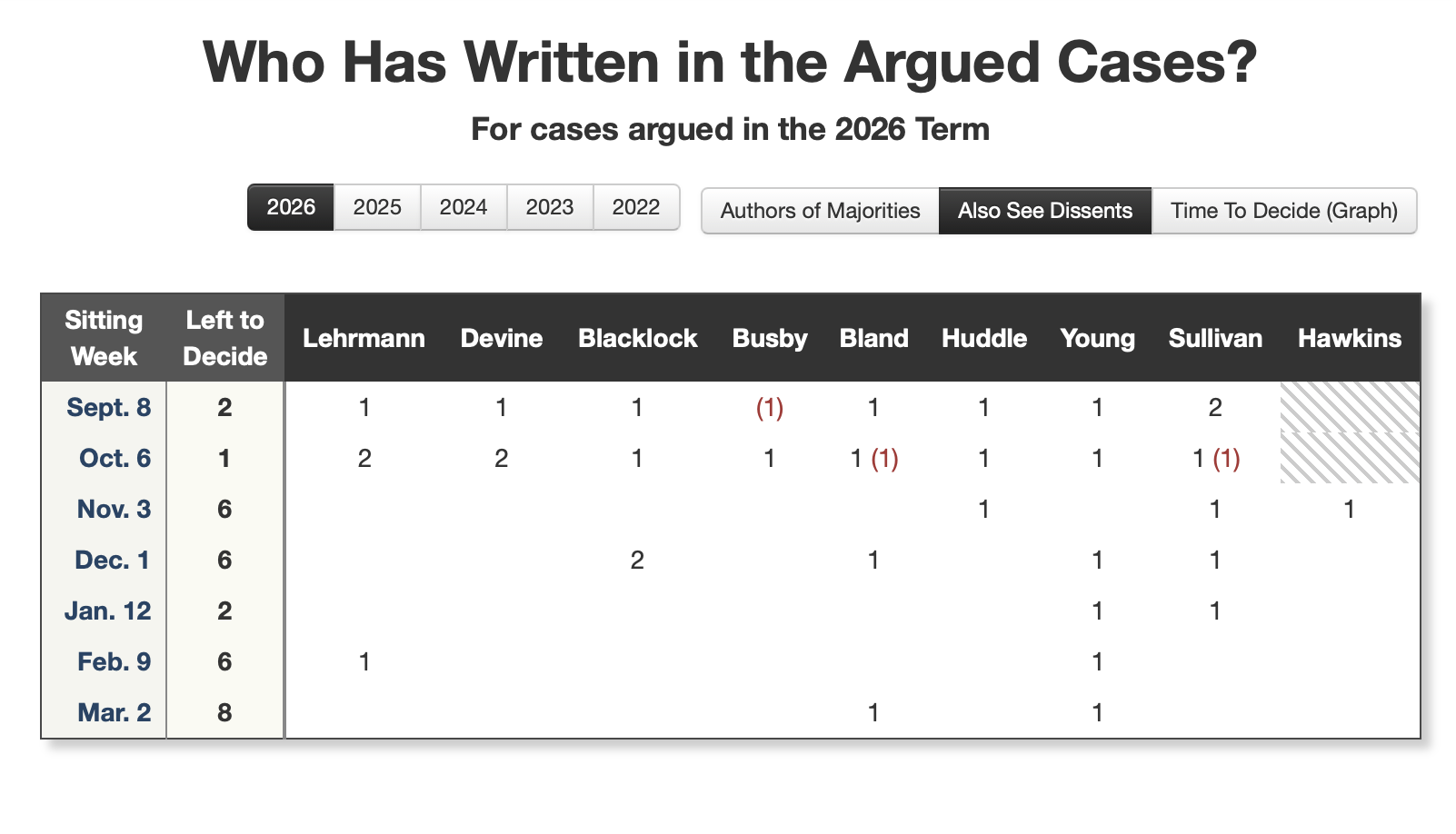
This is wired into my docket-tracking data, so the numbers should update with each new opinion release. If you click on the date of the argument sitting, you will also reach an “argument sitting” detail page listing what cases were heard, their outcomes, and the time to decide each of them.
If this is catnip for you, welcome and enjoy. If you’re wondering who would ever want such a chart, then you can either read on or just continue blissfully with your day.
Reasoning by process-of-elimination
Guessing who will write a specific opinion is a pastime of U.S. Supreme Court watchers. Near the end of a term, you’ll sometimes see them spell this out, step by step, pointing out that a particular justice has not (or already has) written an opinion for an argument sitting that has a high-profile case.1 A chart to make that easier — showing who has and has not written for each argument sitting — appears to be the only stats chart that is live-updated on the current SCOTUSblog website.2
This reasoning begins with an observation: the U.S. Supreme Court tends to assign an equal number of majority opinions to each justice, for each argument sitting. Despite the highly strategic way that authorship of majority opinions is handled in that Court (with the chief or most senior justice who favors the majority outcome making each assignment), the outcome across all the cases smooths out to be consistent with a norm that each justice should write an equal number of majority opinions.
That seems to be honored often enough to make this a useful assumption. That said, it’s certainly not a strict rule. And my intuition is that the time in the Court’s term that the math has been reduced to its simplest form — when the number of remaining cases is very small — is precisely when the internal pressures that might break this norm are most intense. (The end of term is when the most fragmented and contentious cases already tend to cluster.)
What’s a little different in Texas
The Texas Supreme Court also follows a norm that each justice will write a similar number of majority opinions. That’s observable in the opinion totals for each term. And as a matter of process, we have been told that the Texas justices randomly draw for their opinion assignments before argument. That kind of random draw would very naturally tend to distribute those assignments (roughly but not perfectly) across the argument sittings.3
You can see that this pattern holds, but not perfectly, by looking at some charts for recent terms.
One wrinkle with Texas’s random-draw approach is that the justice who draws the initial assignment may find themselves in dissent from the start.4 With that in mind, my chart also lets you quickly see which justices have authored either a majority or a dissent for the sitting. The number of majority opinions is printed in black; the number of dissents is printed in red.
-
When I looked for examples, I came across a 2010 post on SCOTUSblog that tried to guess the authors of “the final four decisions”. By my scoring, that post got one wrong (wrong author; fragmented outcome), two right, and the other was a mixed bag (right author; a fragmented outcome very different than predicted). ↩
-
This is, at least, the only page linked from their navigation. I know they also publish stories from contributors with a statistical bent, such as Adam Feldman of EmpiricalSCOTUS. Perhaps this is a bundling/unbundling business story, where the same channels that used to provide stats insight are now packaged and sold separately? ↩
-
This kind of augury can never be perfect. Even if the Court very strictly followed a mechanical process (which it likely does deviate from, for some reasons too complex for this footnote), we outside observers would not know which nine cases were in any given draw. In Texas, our argument sittings often include more than (or fewer than) nine cases. So the groups of nine do not perfectly align. Obviously, that means some justices may have to write more than one in a sitting. And that ripples downstream, as other justices may then write for more than one in the next sitting. ↩
-
Under the U.S. Supreme Court approach, it would take some kind of realignment of the votes after conference for the justice who receives the initial assignment to end up in dissent. ↩